THE STORY & ITS AFTERLIVES
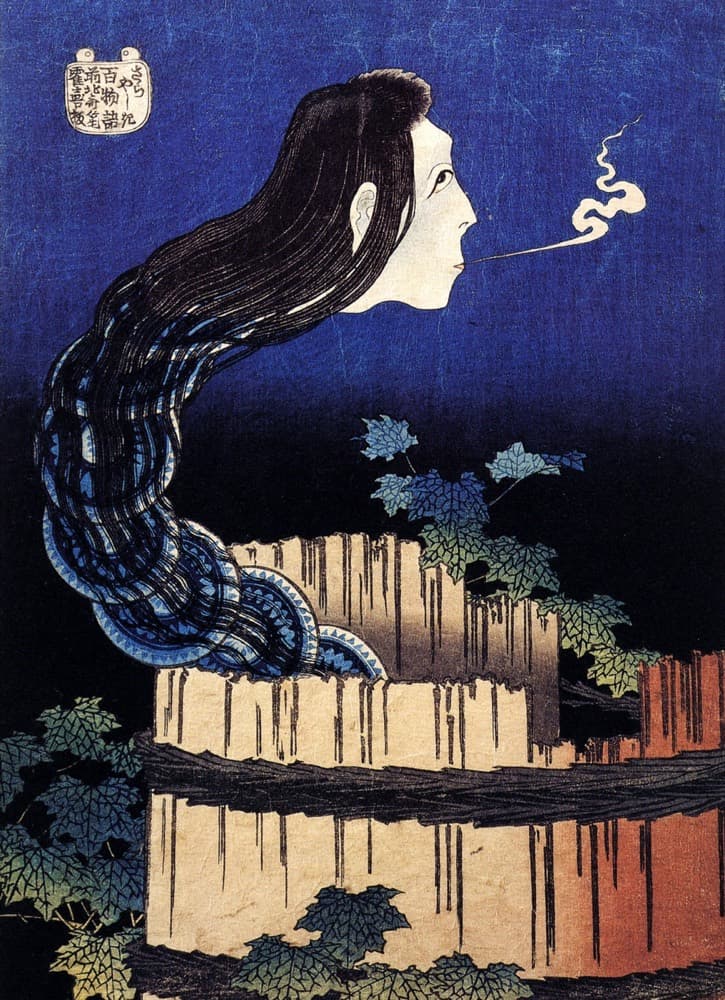
Oiwa was a daughter of the Tamiya family, low-ranking samurai of Yotsuya in Edo, married to the adopted ronin husband Tamiya Iemon. Coveting a marriage into the wealthy Ito household next door, Iemon lets the Itos send Oiwa a poison disguised as medicine. It does not kill her outright: the right side of her face swells and sloughs, and her hair comes out in bloody handfuls as she combs it before a mirror. She dies in rage and grief, and her ghost fastens on Iemon. On his wedding night he sees Oiwa's ruined face where his new bride's should be and cuts the girl down; the face surfaces in lanterns, on mosquito nets, in an eel trap, until both houses, Tamiya and Ito, are destroyed.
Tsuruya Nanboku IV's kabuki play Tokaido Yotsuya Kaidan opened at the Nakamura-za in Edo in the seventh month of 1825, staged on alternating days with the loyal-retainer epic Chushingura, whose world it darkly inverts. The hair-combing scene and the toitagaeshi, a door plank that flips to show Oiwa's corpse nailed to one side and the servant Kohei's to the other, remain celebrated stage machinery. An earlier prose source, the Yotsuya Zatsudanshu of 1727, records the supposed real scandal of Iemon and Oiwa from the Genroku years.
A tradition holds that productions which fail to pay respects at the Oiwa Inari Tamiya shrine in Yotsuya suffer accidents, so casts still visit before opening night. Films by Kinoshita Keisuke (1949) and Nakagawa Nobuo (1959) fixed her half-ruined face as the founding image of the Japanese ghost-film heroine.