THE STORY & ITS AFTERLIVES
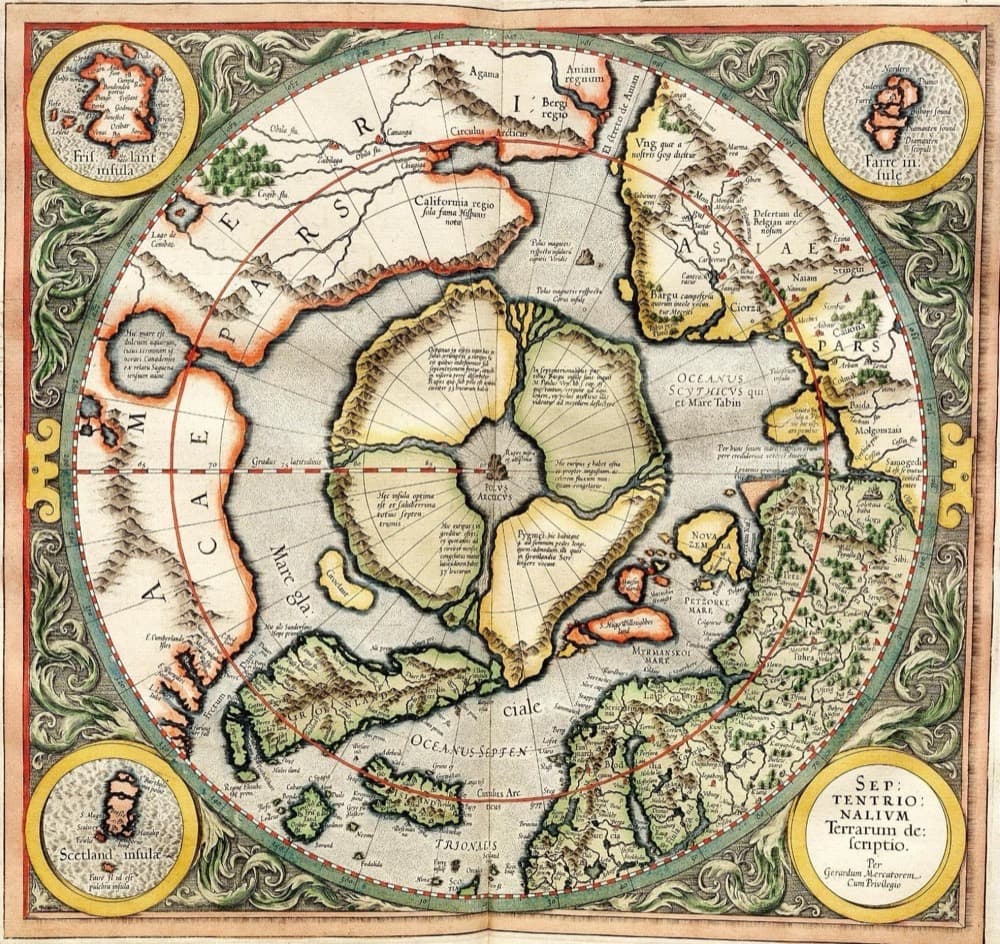
Thule differs from other lost lands in springing from a real voyage. Around 325 BCE Pytheas, a Greek navigator from Massalia (Marseille), sailed past Gibraltar, circumnavigated Britain, and pressed north; his book On the Ocean described the island of Thule six days' sail beyond Britain, where around midsummer the sun scarcely set, the inhabitants brewed drink from grain and honey, and one day's sail further the ocean congealed into something like a "sea-lung", sea, air, and fog indistinguishable and impassable to ships. The book itself is lost, surviving only in quotations by Strabo, Pliny, and others; Strabo mocked Pytheas as an arch-liar, though modern scholarship largely accepts the voyage as genuine.
Where Thule lay has never been settled: Iceland, the mid-Norwegian coast, Shetland, and the Faroes all have champions, and the congealed sea is usually read as the edge of drift ice or ice slush in fog. Virgil's phrase "ultima Thule" in the Georgics fixed it in Latin letters as a byword for the outermost limit of the known world.
Its modern echoes span opposites. The Danish explorer Knud Rasmussen named his 1910 trading post in northwest Greenland Thule, later the site of the American Thule Air Base. In 1918 the occult-nationalist Thule Society of Munich recast the island as the polar homeland of an "Aryan race", and its circle overlapped with the early Nazi party — a career with no connection to Pytheas's log. In 2019 the Kuiper Belt object visited by New Horizons carried the nickname Ultima Thule before being formally named Arrokoth.