THE STORY & ITS AFTERLIVES
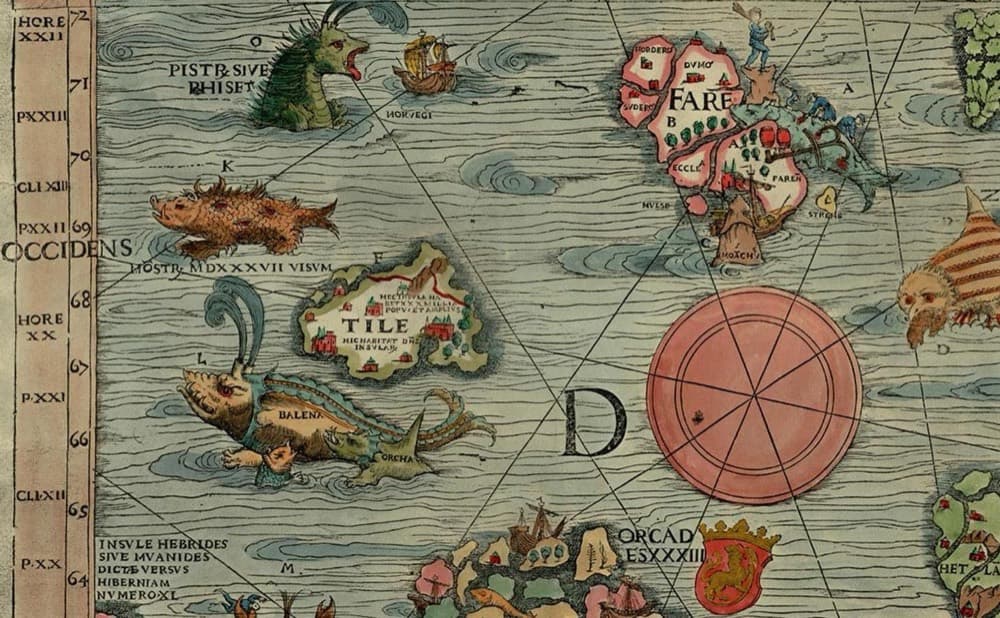
Hy-Brasil is the longest-lived phantom island in the history of cartography. Around 1325 the Genoese chartmaker Angelino Dulcert marked a round island labelled "Bracile" west of Ireland on his portolan chart, and for more than five centuries it migrated across European maps under spellings like Brasil and Hy-Brasil, usually drawn as a neat circle split by a channel. The name likely derives from the Irish Uí Breasail, the clan-land of Breasal, and has nothing to do with the brazilwood that later named Brazil. In Irish folklore it is a blessed country sealed in fog that lifts for a single day every seven years, when the island stands on the horizon yet recedes from every ship that steers for it.
People genuinely went looking. Bristol merchants sent ships out in 1480 and again in 1481 expressly to find the isle of Brasil; in 1497 a Spanish envoy in London reported that the "new found land" of John Cabot was taken to be the very Brasil the Bristol men had long sought. A London pamphlet of 1674 recounted how the Irish captain John Nisbet landed on the island and met a magician and monstrous rabbits, a tale scholars generally credit to the satirist Richard Head. As surveys sharpened, the island shrank on the charts to a mere "Brasil Rock" and was finally struck from British Admiralty charts in the 1870s.
Its substance was probably a conspiracy of low cloud, sea fog, and mirage on the west Irish horizon; the submerged Porcupine Bank, lying roughly where the charts drew the island, is a favoured candidate for its "real" body. In Irish letters and New Age writing, Hy-Brasil remains the byword for a paradise glimpsed through fog.