THE STORY & ITS AFTERLIVES
Thoth is usually an ibis-headed man holding the scribe's palette and reed pen, crowned with a lunar disk resting in a crescent; his other animal form is the baboon. Egyptians credited him with inventing writing and every branch of learning, and the scribes who ran the Egyptian state claimed him as patron. As a moon god he governed the calendar and the reckoning of time; as 'Lord of Divine Words' he served as secretary and arbiter of the gods.
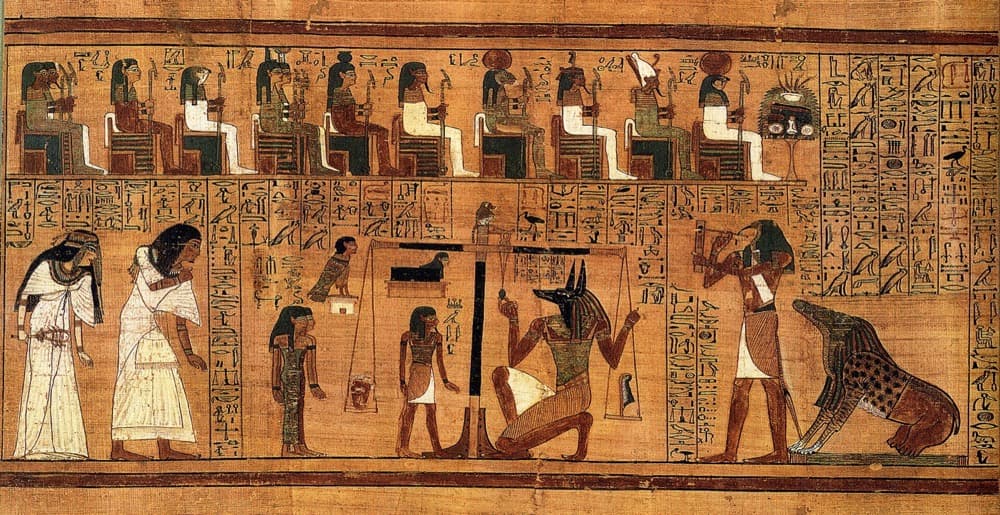
He plays the decisive supporting role in several central myths. Plutarch relates that when Ra forbade the sky goddess Nut to give birth on any day of the year, Thoth won a portion of moonlight in a game and fashioned five extra days outside the calendar, on which Nut bore her children, Osiris, Isis, Set, and Nephthys among them. It was Thoth who healed the eye of Horus torn out by Set, restoring it as the wedjat, the whole eye. In the judgment scene of Book of the Dead spell 125 he stands beside the balance with his papyrus roll, records the result of the weighing, and announces the verdict to Osiris.
His cult center was Hermopolis in Middle Egypt, Egyptian Khemenu, 'Eight-Town'; the catacombs at nearby Tuna el-Gebel hold millions of mummified ibises. The Greeks identified him with Hermes, and in the Ptolemaic fusion he became Hermes Trismegistus, the named author of the Hermetic writings of late antiquity.