THE STORY & ITS AFTERLIVES
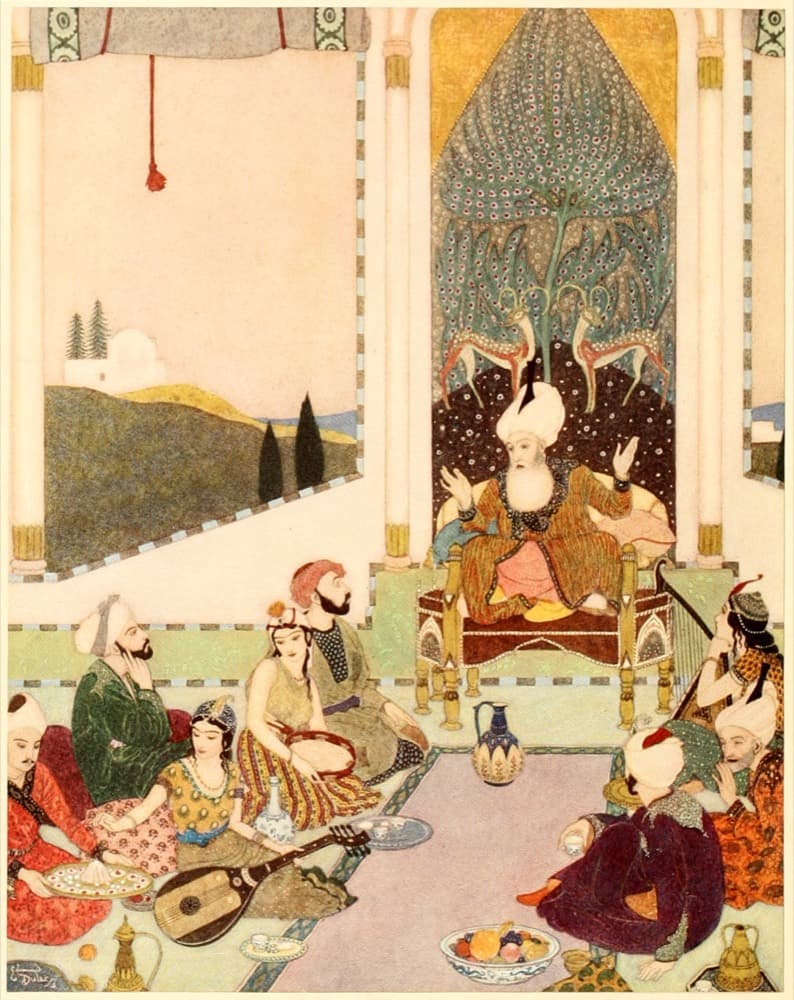
The frame tale runs: King Shahriyar, finding his queen unfaithful, has her executed and resolves to marry a virgin each night and kill her at dawn, so that no wife will ever betray him. After three years the city is emptied of daughters, and the vizier charged with finding brides despairs — until his elder daughter Scheherazade volunteers. She has read a thousand books, the histories of kings, poetry, philosophy and medicine. On her wedding night she arranges for her sister Dunyazade to sit with them and beg, as agreed, for one story to pass the night. The story reaches its crisis exactly at daybreak, the appointed hour of execution, and the king stays the sword to hear the rest. Night follows night, tale nested in tale — the merchant and the jinni, the fisherman, the porter and the three ladies of Baghdad — until after a thousand and one she has borne the king children and he formally renounces the killing.
The frame is far older than most of its contents. Two tenth-century works, al-Mas'udi's Meadows of Gold and Ibn al-Nadim's Fihrist, describe a book translated from the Persian Hazar Afsan, 'A Thousand Tales', whose heroine bears this name; Ibn al-Nadim sniffs at it as a coarse book. The oldest physical witness is a ninth-century paper fragment, published by the scholar Nabia Abbott in 1949, carrying the title 'A Thousand Nights' and Dunyazade's opening plea for a story.
Scheherazade became the figure of narrative itself: keep telling, keep living. Rimsky-Korsakov's 1888 suite gave her a solo violin for a voice, and Borges liked to cite the (legendary) six hundred and second night, on which the story is said to loop back to its own beginning.