THE STORY & ITS AFTERLIVES
Rama is the eldest prince of Ayodhya in the kingdom of Kosala, dark-skinned, bow on shoulder, revered as the seventh avatar of Vishnu and the very embodiment of dharma—the epic calls him the ideal son, husband and king. As a youth, studying under the sage Vishvamitra, he bent and broke the bow of Shiva that no man could string, winning the hand of Sita, daughter of King Janaka.
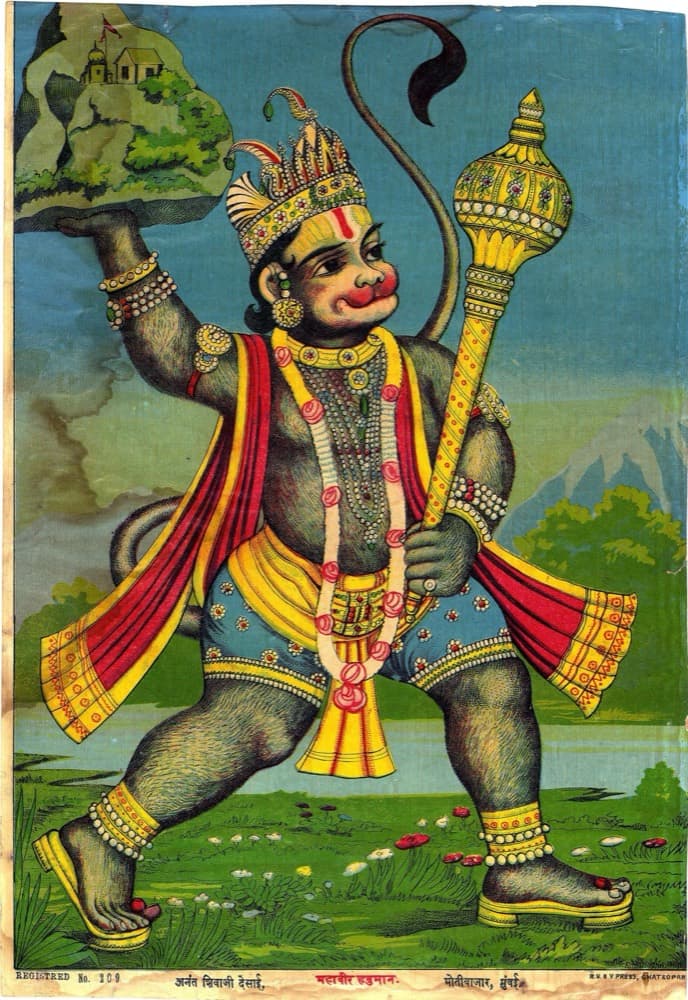
Valmiki's Ramayana—seven books, some 24,000 verses, composed between roughly the 5th century BCE and the early centuries CE—tells his story. On the eve of his coronation his father, bound by an old promise, exiled him for fourteen years; Rama walked into the forest without complaint, Sita and his brother Lakshmana beside him. The demon king Ravana lured the brothers away and carried Sita off to Lanka. Rama allied with the monkey king Sugriva; Hanuman leapt the ocean and found Sita; the monkey and bear armies bridged the strait with boulders—Rama's Bridge—and in the war that followed Rama drove the arrow of Brahma through Ravana's heart. When he returned to Ayodhya, the city was lit with rows of lamps: one origin of the festival of Diwali. The epic's last book turns bitter: yielding to public gossip, Rama banished the pregnant Sita, who bore him twin sons in Valmiki's hermitage and at last asked the earth, her mother, to take her back.
'Rama Rajya' remains a byword for the just kingdom. The epic spread across Asia as Thailand's Ramakien and Cambodia's Reamker, and the kings of Thailand's Chakri dynasty reign to this day under the name Rama. In modern India the site held to be his birthplace at Ayodhya became the centre of a bitter dispute; the new Rama temple there was consecrated in 2024.