THE STORY & ITS AFTERLIVES
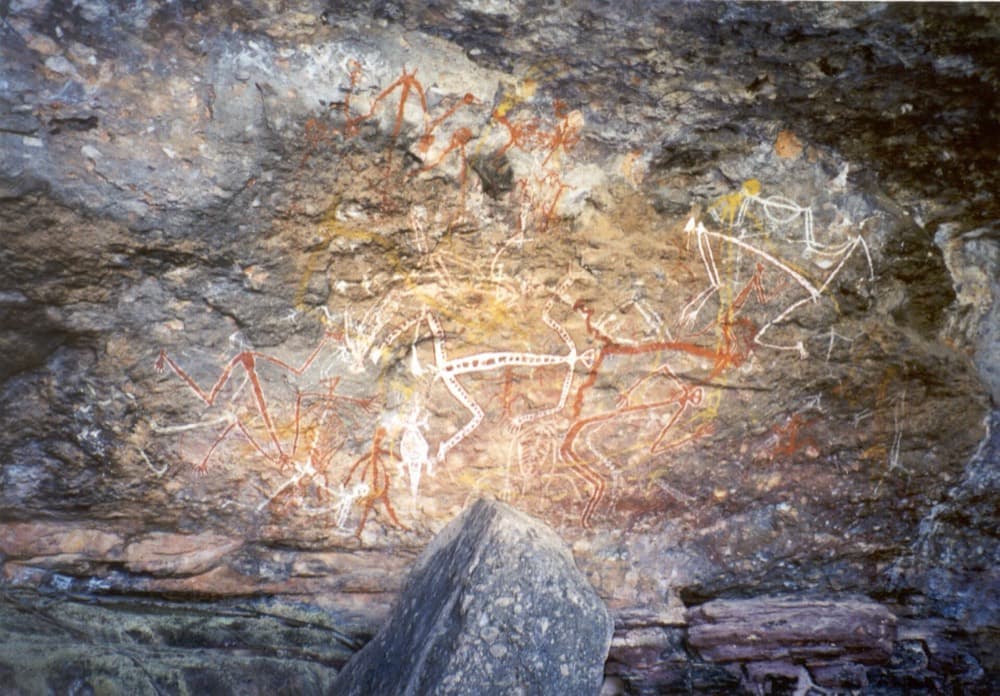
Namarrkon is instantly recognisable: a luminous band runs from his head, out through his hands, and down past his hips, enclosing his whole body in a hoop of lightning, and stone axes are bound to his head, elbows, and knees. When the monsoon storms build, he rides the tops of the thunderheads surveying the country; a blow of his axe against the cloud is the thunderclap, the flicker of his band the lightning. Through the dry season he keeps his distance in the sky, and Bininj can point to where he waits. From him come the rules for behaviour under a storm: no shouting, no mocking the thunder, lest he be provoked to throw an axe.
His children are the alyurr — Leichhardt's grasshoppers, brilliant in orange and blue — which emerge on the stone country in November and December, just as the first storms of the wet season gather. Tradition reads their appearance as Namarrkon's children calling their father to bring the rain: a precise interlocking of insect phenology and narrative, and a textbook case of how Arnhem Land oral knowledge encodes the seasonal calendar in story.
In 1964 the Badmardi painter Nayombolmi, known as Barramundi Charlie, repainted Namarrkon and his family group at the Anbangbang shelter at Burrungkuy (Nourlangie) in Kakadu — the final work in a lifetime of hundreds of rock paintings. The X-ray-style Lightning Man is now the centrepiece of the park's interpretive walk, where Bininj guides still tell visitors his rules as the storm season turns.