THE STORY & ITS AFTERLIVES
Lemuria began as sober science. In an 1864 paper, The Mammals of Madagascar, the English zoologist Philip Sclater noted that lemurs occur in Madagascar and India but not on the African mainland or in the Middle East, and proposed a since-sunken continent spanning the Indian Ocean to explain it, naming it after the lemurs. Ernst Haeckel went further and suggested it might be the cradle of mankind. Once continental drift and plate tectonics were established, science dropped the hypothesis: the breakup of Gondwana explains the distribution.
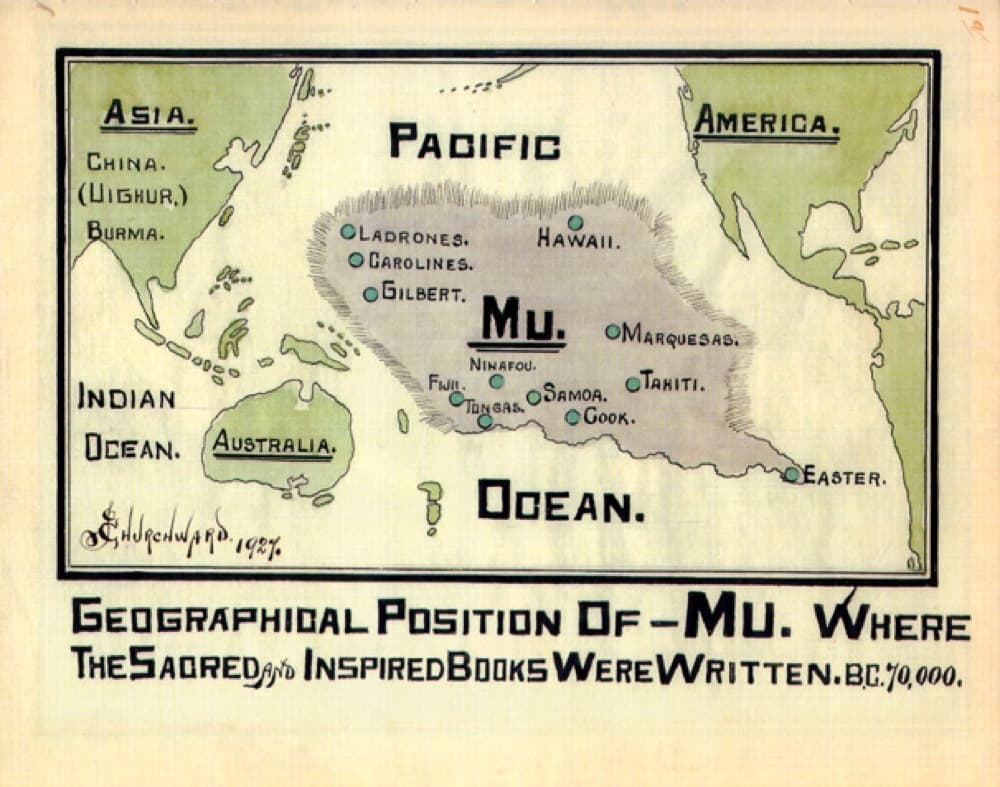
Esoterica kept Lemuria alive. In The Secret Doctrine (1888) Helena Blavatsky made it the home of the Third Root Race, egg-laying hermaphrodite giants several metres tall with a third eye in the forehead, whose lineage survived the continent's destruction. In the early twentieth century Frederick Spencer Oliver's channelled novel A Dweller on Two Planets (published 1905) relocated Lemurian survivors to Mount Shasta in California, spawning tales of white-robed strangers slipping into mountain towns; the mountain remains a centre of New Age pilgrimage.
In South India, twentieth-century Tamil writers fused Lemuria with older literary traditions of a homeland swallowed by the sea, naming it Kumari Kandam and citing it as proof of the antiquity of Tamil civilization, a narrative still current in Tamil nationalist discourse.