THE STORY & ITS AFTERLIVES
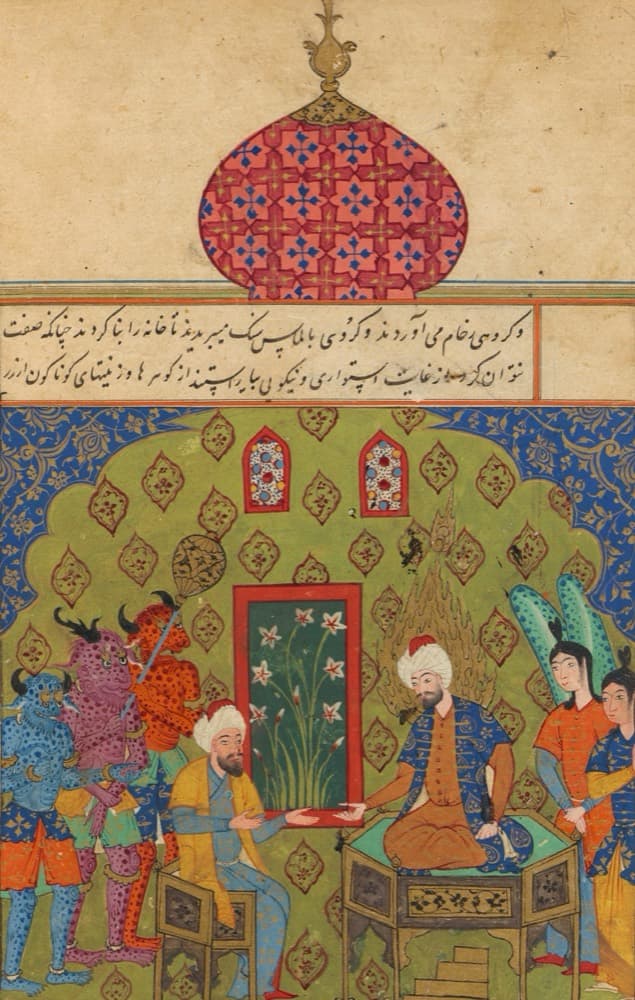
The flying carpet has two lineages. The older belongs to Solomon. The Quran says the wind was made to serve him, and legend compendia such as al-Tha'labi's eleventh-century Lives of the Prophets spread that verse into a vast carpet of green silk: the king's throne at the centre, men ranked on one side and jinn on the other, birds flying wing to wing overhead for shade, the whole freight borne by the wind a month's journey by morning and a month's by evening. The tradition adds a moral: when Solomon's heart swelled with pride, the wind would give a shake and spill a few thousand riders, by way of correction.
The second lineage comes from the Thousand and One Nights. In the tale of Prince Ahmed and the fairy Pari Banu, the three sons of a sultan of the Indies scatter in search of wonders, and the eldest, Husain, pays forty purses of gold in the bazaar of Bisnagar for a small, shabby-looking rug: sit on it, wish, and you are there. Carpet, ivory spyglass and healing apple together save a dying princess. Like Aladdin, the tale is one of the 'orphan stories' Hanna Diyab told Galland in 1709, with no earlier Arabic text.
As the dream of arrival without motion, the carpet became the Nights' lightest emblem. Vasnetsov painted a Russian prince riding one in 1880; The Thief of Bagdad (1924) sent it aloft on screen; Disney's Aladdin (1992) gave it a personality — though in Galland's actual Aladdin, the hero never once sits on a carpet.