THE STORY & ITS AFTERLIVES
The title 'Book of the Dead' is modern: in 1842 the Prussian scholar Karl Richard Lepsius published a Turin papyrus as 'Das Todtenbuch der Ägypter' and assigned the chapter numbers still in use. The Egyptians called it the 'Spells of Coming Forth by Day' — utterances enabling the dead to move freely in and out of the netherworld in daylight and take what forms they wished. The corpus runs to roughly two hundred chapters, but no standard edition ever existed: workshops copied a selection matched to the buyer's purse onto a papyrus roll placed in the burial, the finest examples running over twenty meters with painted vignettes, the owner's name filled into blanks throughout.
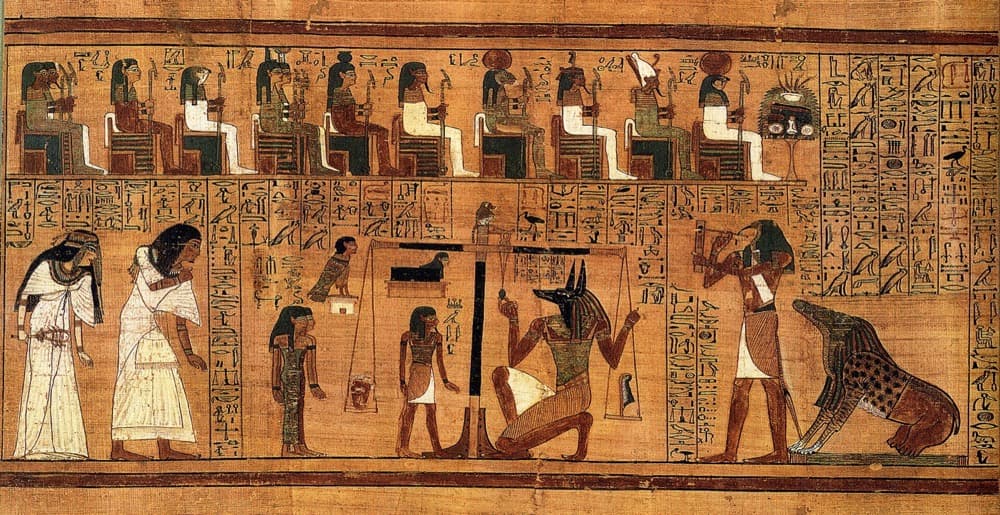
It is the last stage of nearly two millennia of funerary literature: the Pyramid Texts of the Old Kingdom, first carved in the pyramid of Unas around 2350 BCE, were reserved for kings; the Coffin Texts of the Middle Kingdom spread onto the coffins of officials and commoners; from the New Kingdom (c. 1550 BCE) the spells moved to papyrus and the afterlife opened to anyone who could afford a scroll. The contents cover every posthumous contingency — spells to keep one's name and heart, to avoid walking upside down, to transform into a bennu bird or a lotus, to name the guardians of the gates — centered on the judgment of spell 125.
Hundreds of copies survive. The most celebrated, the Papyrus of Ani, about 24 meters long, was acquired by the British Museum in 1888 (EA 10470), and its judgment vignette remains the standard image of the Egyptian afterlife.