THE STORY & ITS AFTERLIVES
Osiris appears as an upright mummy: body wrapped in white linen, hands crossed over the chest holding the crook and flail of kingship, head bearing the atef crown, a white miter flanked by two ostrich feathers. His skin is painted green or black, the colors of sprouting vegetation and of the fertile silt left by the Nile flood. He is at once lord of the dead, god of resurrection, and god of agricultural abundance, the river's annual rise and fall being read as the rhythm of his death and revival.
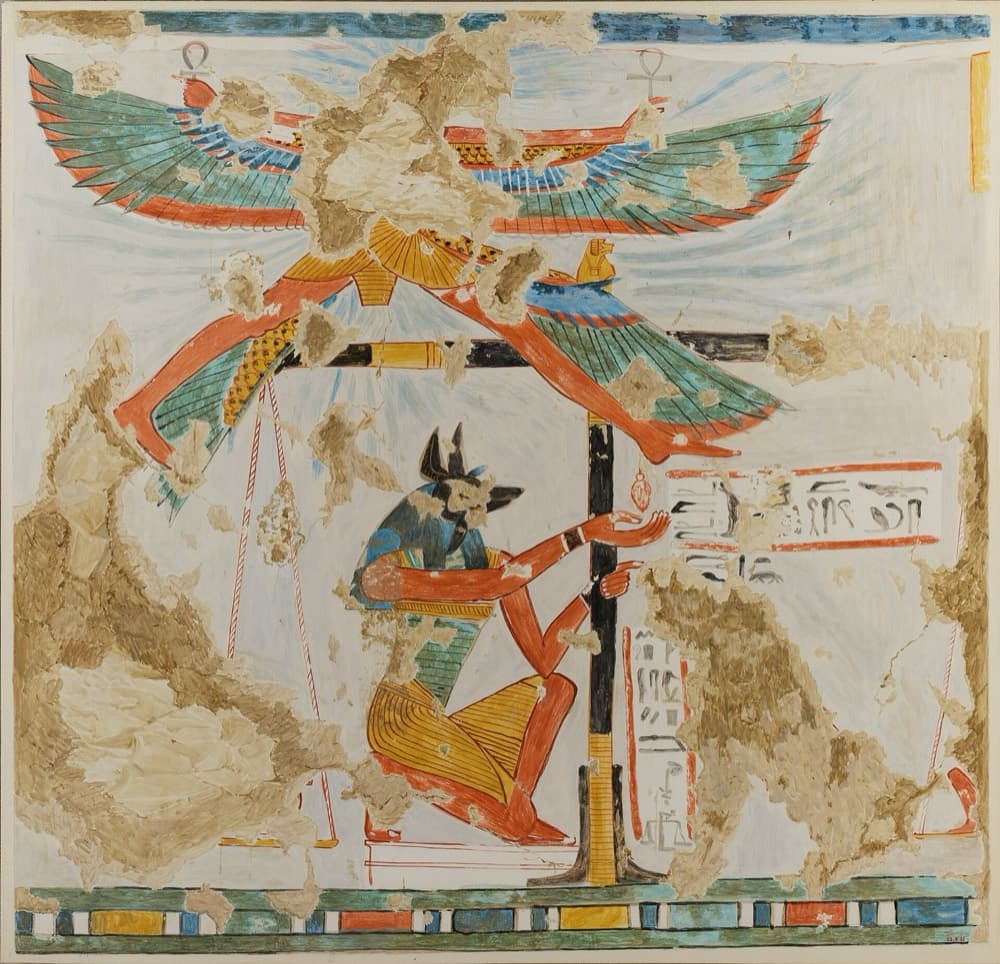
His myth was Egypt's most widely told story. Osiris ruled on earth as a good king until his jealous brother Set tricked him at a banquet into lying inside a splendid chest built to his measure, nailed it shut, and threw it into the Nile. After Isis recovered the body, Set dismembered it, in Plutarch's account into fourteen pieces scattered across Egypt. Isis and her sister Nephthys gathered the parts, Anubis bound them into the first mummy, and Isis, hovering as a kite, fanned breath back into her husband and conceived their son Horus. The revived Osiris thereafter remained in the Duat, presiding over the judgment of the dead in the Hall of Two Truths.
Abydos was his great sanctuary, where annual mystery plays reenacted his passion from the Middle Kingdom onward. From the Pyramid Texts on, the dead king was identified with Osiris; by the New Kingdom every properly buried person was called 'the Osiris so-and-so.'