THE STORY & ITS AFTERLIVES
Fuxi, also written Paoxi, heads the traditional list of the Three Sovereigns. Han-dynasty reliefs pair him with Nüwa, both human-headed and serpent-bodied, their tails entwined; he holds the carpenter's square to her compass, together measuring earth and heaven. The 'Great Commentary' to the Book of Changes credits him with the eight trigrams: ruling the world in high antiquity, he looked up to observe the figures in the sky and down to observe the patterns of the earth, studied the markings of birds and beasts, and devised the trigrams to reach the powers of the spirits and classify the natures of the ten thousand things.
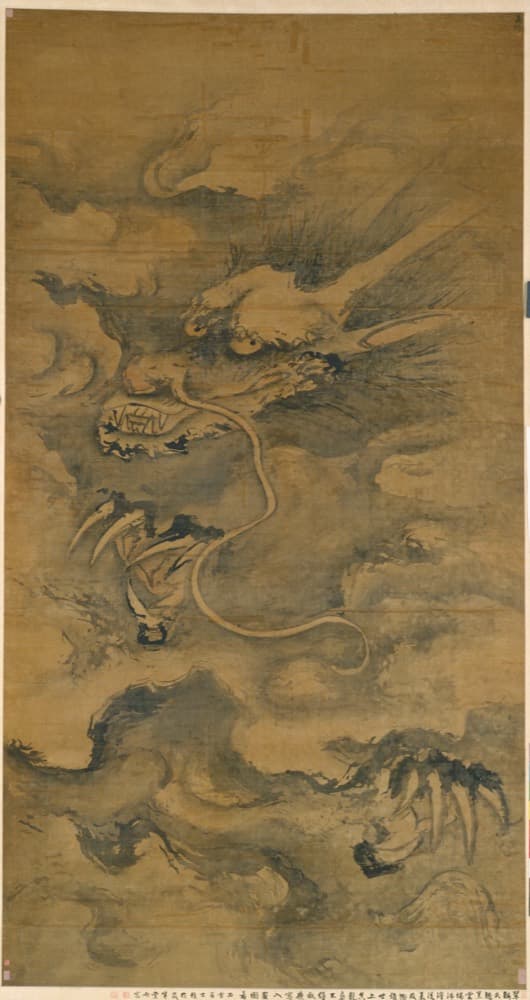
Tradition further makes him the inventor of knotted-cord nets for fishing and hunting, and the founder of marriage rites sealed with paired deerskins. A dragon-horse was said to have risen from the Yellow River bearing the River Chart, from which he drew the trigrams. The Tang scholar Sima Zhen gathered these traditions into his 'Annals of the Three Sovereigns', a supplement to the Records of the Grand Historian, while Huangfu Mi's Diwang Shiji records that his mother conceived him after stepping in a giant's footprint.
Tianshui in Gansu claims his birthplace, the ancient Chengji, and its Ming-dynasty Fuxi Temple still hosts annual state ceremonies; at Huaiyang in Henan he is worshipped merged with Taihao, god of the east, at the Taihao Mausoleum.