THE STORY & ITS AFTERLIVES
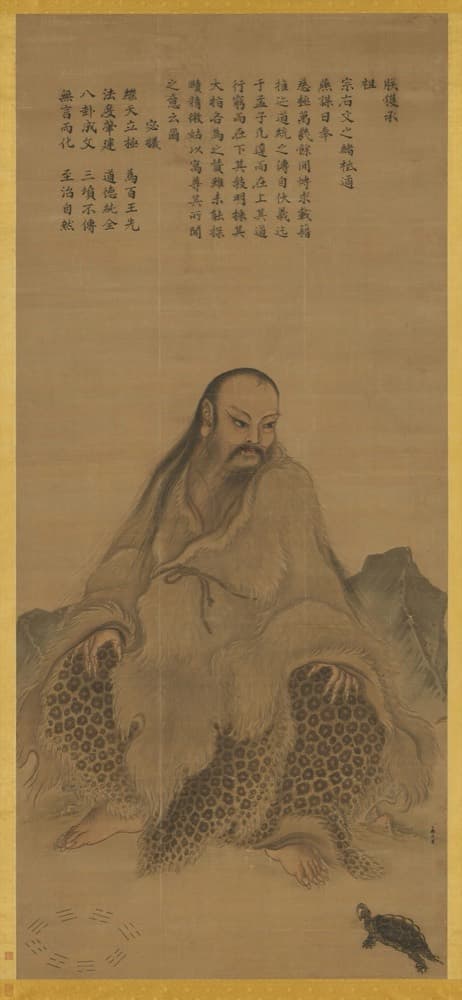
Nüwa is among the oldest of Chinese deities. Han-dynasty tomb reliefs show her with a human head and a serpent's body, her tail intertwined with that of Fuxi, a compass often in her hand. The Fengsu Tongyi of Ying Shao (2nd century CE) preserves the story of how she created humanity: alone in a newly opened world, she kneaded figures from yellow clay one by one, then, overwhelmed by the labor, dragged a cord through the mud and flicked it, so that the scattered drops also became people.
Her greatest deed is the mending of heaven. The Huainanzi tells how, in remote antiquity, the four pillars of the world collapsed and the nine regions split open; fires raged, floods spread, and beasts of prey devoured the people. Nüwa smelted five-colored stones to patch the azure sky, cut the legs from a giant turtle to prop up the four quarters, slew a black dragon to save the land of Ji, and piled reed ashes to dam the waters. Later tradition linked this catastrophe to Gonggong's toppling of Mount Buzhou.
The 'Heavenly Questions' of the Chu ci already asks who could have fashioned Nüwa's own body, proof that her myth circulated by the Warring States period. Later folklore made her and Fuxi a sibling couple who repopulated the world after a flood, and she is venerated as creator, sky-mender, and patroness of marriage, with an active cult at the Wahuang Palace in Shexian, Hebei.