THE STORY & ITS AFTERLIVES
The fenghuang reigns over all birds: feng names the male, huang the female. The Shuowen Jiezi locates its home in the Country of Gentlemen in the east, whence it soars beyond the four seas, past Kunlun, drinks at the Dizhu rapids, and roosts in the Cave of Winds; its appearance signals great peace under heaven. Guo Pu's commentary on the Erya assembles its anatomy: cock's head, swallow's chin, snake's neck, tortoise's back, fish's tail, feathers of the five colors, standing some six feet tall.
It heads the roster of auspicious signs. When the Xiaoshao music played at Shun's court, the Book of Documents says, 'the phoenix came and danced'; the Guoyu records that the rise of Zhou was announced by a phoenix-kind crying on Mount Qi, ever after the classic omen of a dynasty about to flourish. The Book of Songs sings 'the phoenixes fly, whirring their wings', still a stock phrase of congratulation, while the yuanchu of Zhuangzi's parable — a phoenix that perches only on wutong trees, eats only bamboo seed, and drinks only from sweet springs — fixed the bird as an emblem of incorruptible purity.
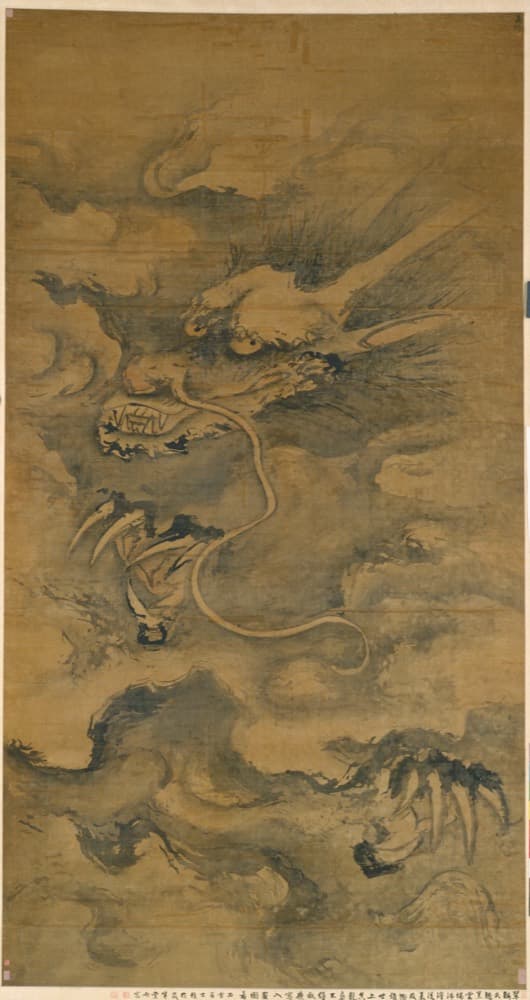
The culture of Chu was especially devoted to the feng, whose image stands triumphant over dragons and tigers on Chu silk paintings and lacquers. From Han times the phoenix was paired with the empress as the dragon was with the emperor: phoenix crowns dressed brides and consorts alike, and the motif of the phoenix among peonies spread across textiles, porcelain, and rooflines.