THE STORY & ITS AFTERLIVES
The amaru is the great serpent of the Andean world. The Quechua dictionary compiled by González Holguín in 1608 glosses the word simply as 'dragon, serpent'. It dwells in the depths of Ukhu Pacha, the world below, and moves among highland lakes, springs and underground channels of water. On Andean textiles and pottery the amaru is often shown with two heads, one turned downward and one to the sky, its body spanning the field of the design and joining underworld, middle world and heavens into a single road. The motif is far older than the Incas, reaching back through the imagery of Tiwanaku and earlier cultures.
It belongs to water in all its forms. Andeans read the rainbow as the amaru's body: the serpent arches up out of a spring, crosses the sky, and bends its head to drink at another water source. For that reason the rainbow was no good omen — it was thought to bring illness, and people avoided pointing at it. When the order of the world neared overturning — pachakuti, the turning-over of space and time — the amaru was said to rise from lake beds and fissures. Highland villages still tell of great serpents asleep in this or that black lake.
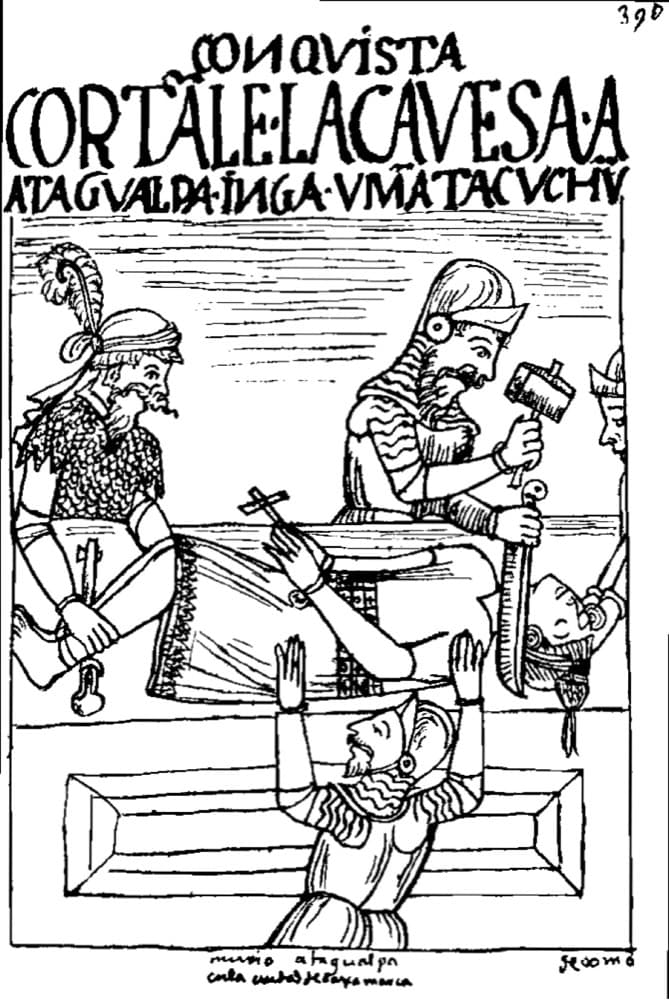
Inca royalty took the creature into its names: Amaru Topa was brother to Tupac Inca Yupanqui; the last Inca of Vilcabamba, executed on the plaza of Cusco in 1572, was Túpac Amaru, 'royal serpent'; and in 1780 José Gabriel Condorcanqui rose against colonial rule as Túpac Amaru II. The name became part of the Andean memory of resistance.