THE STORY & ITS AFTERLIVES
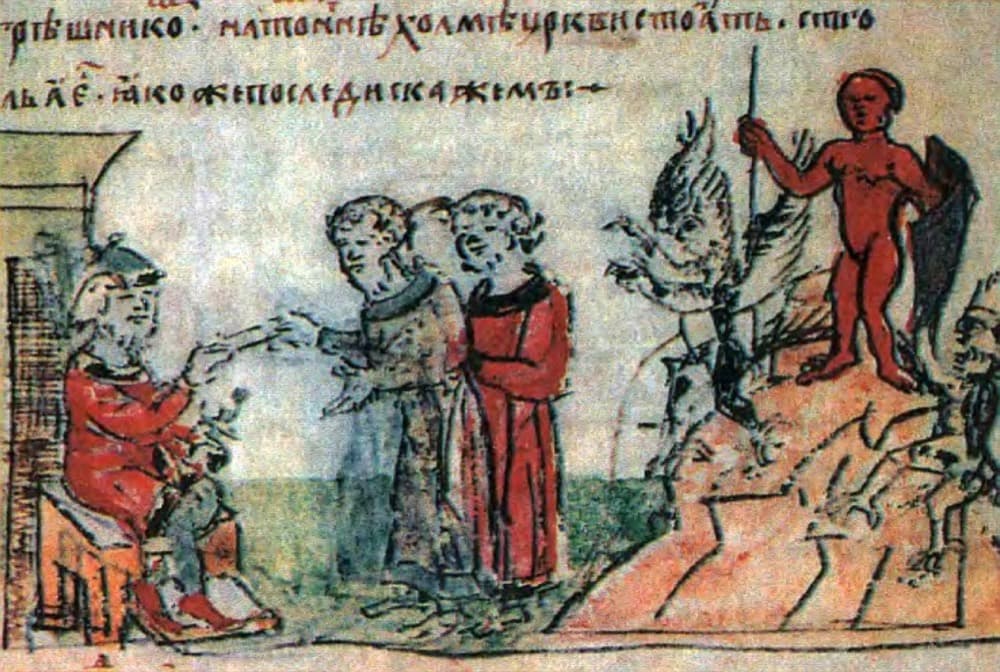
Svarog is the god of heavenly fire and the smith's craft. His chief attestation is the entry for 1114 in the Hypatian Codex, where the chronicler, translating the Byzantine chronicle of John Malalas, added a gloss rendering the Greek smith god Hephaestus as Svarog and calling the sun god Dazhbog "son of Svarog." In this passage, tongs fell from the sky during Svarog's reign and people learned to forge weapons; he also instituted the law of one husband and one wife, casting offenders into a furnace.
In Old Rus sermons "Svarozhich," son of Svarog, named the fire that peasants venerated as a god: churchmen complained that people "pray to fire, calling it Svarozhich," typically at the drying barn where grain was cured. The West Slavs on the southern Baltic shore worshipped a deity of the corresponding name: Thietmar of Merseburg recorded in the early eleventh century that the temple at Radogost (Rethra), holy city of the Lutici, housed an armoured war god called Zuarasici, consulted by lot before campaigns.
With so few direct sources, most of Svarog's genealogy is scholarly reconstruction; Romantic writers from the nineteenth century onward inflated him into a Slavic sky-father and progenitor of the gods, for which the medieval texts give no warrant. Etymologists compare his name with Indo-Iranian svar, "sunlight," while others derive it from Slavic svara, "quarrel"; the question stays open.