THE STORY & ITS AFTERLIVES
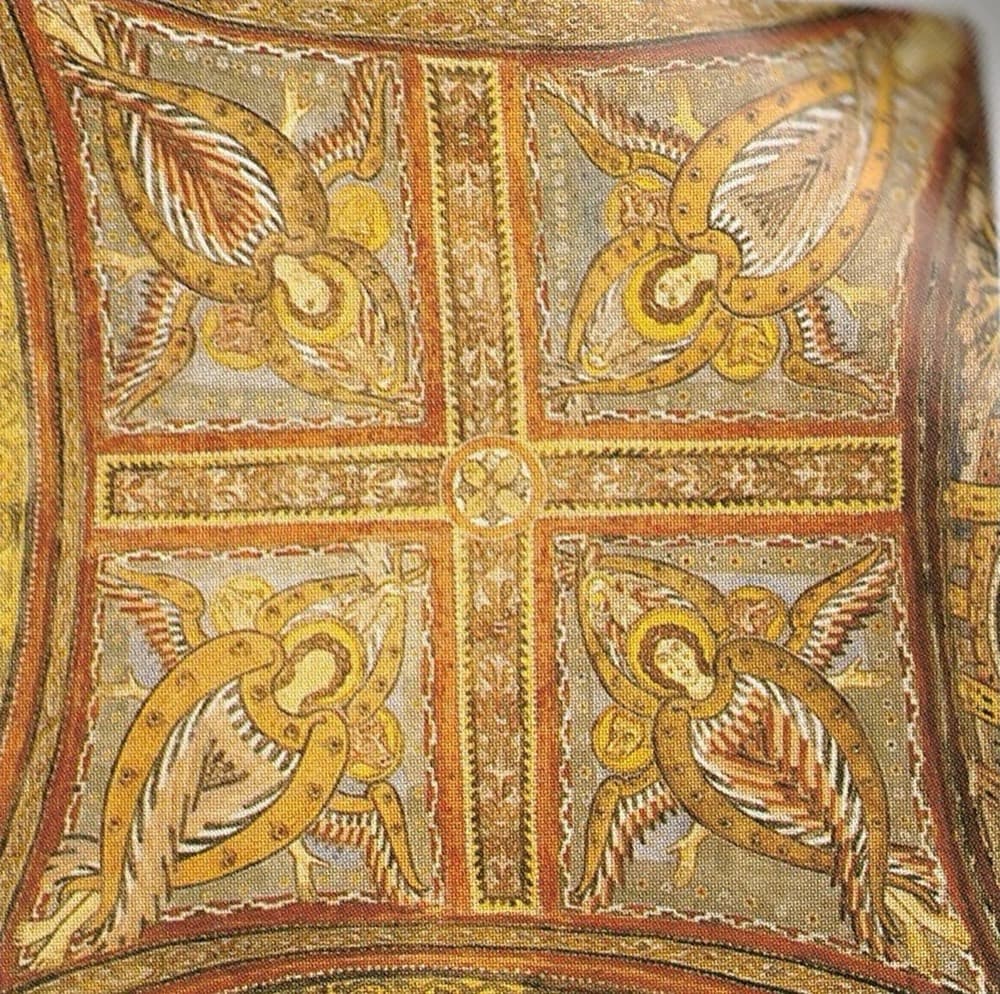
The seraphim appear directly only in Isaiah 6. In the year King Uzziah died, the prophet saw the Lord seated on a high and lofty throne, the hem of his robe filling the temple, and seraphim standing above him: each had six wings — two covering the face, two covering the feet, two for flight — and they called to one another, 'Holy, holy, holy is the Lord of hosts; the whole earth is full of his glory.' The sound shook the thresholds on their foundations, and the house filled with smoke. One seraph flew to Isaiah with a live coal taken with tongs from the altar, touched his lips, declared his guilt removed, and the prophet received his commission.
The Hebrew saraph derives from the verb 'to burn.' The same word names the fiery serpents that bite Israel in the wilderness in Numbers 21 and the 'flying fiery serpent' of Isaiah 14, so scholars generally see a serpentine, flame-wreathed figure behind the seraphim; the winged uraeus serpents of Egyptian and Levantine iconography are often cited as kin. In the vision of chapter 6, however, they are already courtiers of the throne, singers of the threefold Holy.
Around the fifth or sixth century, the writer known as Pseudo-Dionysius the Areopagite placed the seraphim first among the nine choirs of angels in his Celestial Hierarchy, nearest to God, their name glossed as 'those who kindle and give heat'; Dante's Paradiso follows him. The Sanctus entered both the synagogue Kedushah and the Christian mass, where it is still sung daily. In art the seraphim burn red, often a single face wrapped in six wings.