THE STORY & ITS AFTERLIVES
In the midst of the great wilderness, says the southern classic, live people with one head and three bodies. Di Jun's wife Ehuang bore this nation; its people are surnamed Yao, eat millet, and command the 'four birds' — a list that other wilderness passages spell out as leopard, tiger, and the two great bears, 'bird' serving as a loose word for beast. The Beyond the Seas: West chapter locates the country north of Qi, lord of the Xia, and the Huainanzi counts the Three-Bodied among the thirty-six nations beyond the seas.
The genealogy carries a buried clue. Yao is the surname of the sage-king Shun, and Ehuang is the name of the elder daughter of Yao the sage-king, given to Shun in marriage. Yuan Ke's critical commentary treats this as key evidence that Di Jun and Shun are one figure split in two: in the wilderness classics Di Jun marries Ehuang and fathers a Yao-surnamed nation; in the transmitted histories Shun bears the surname Yao and marries Ehuang — the same tradition wearing two faces.
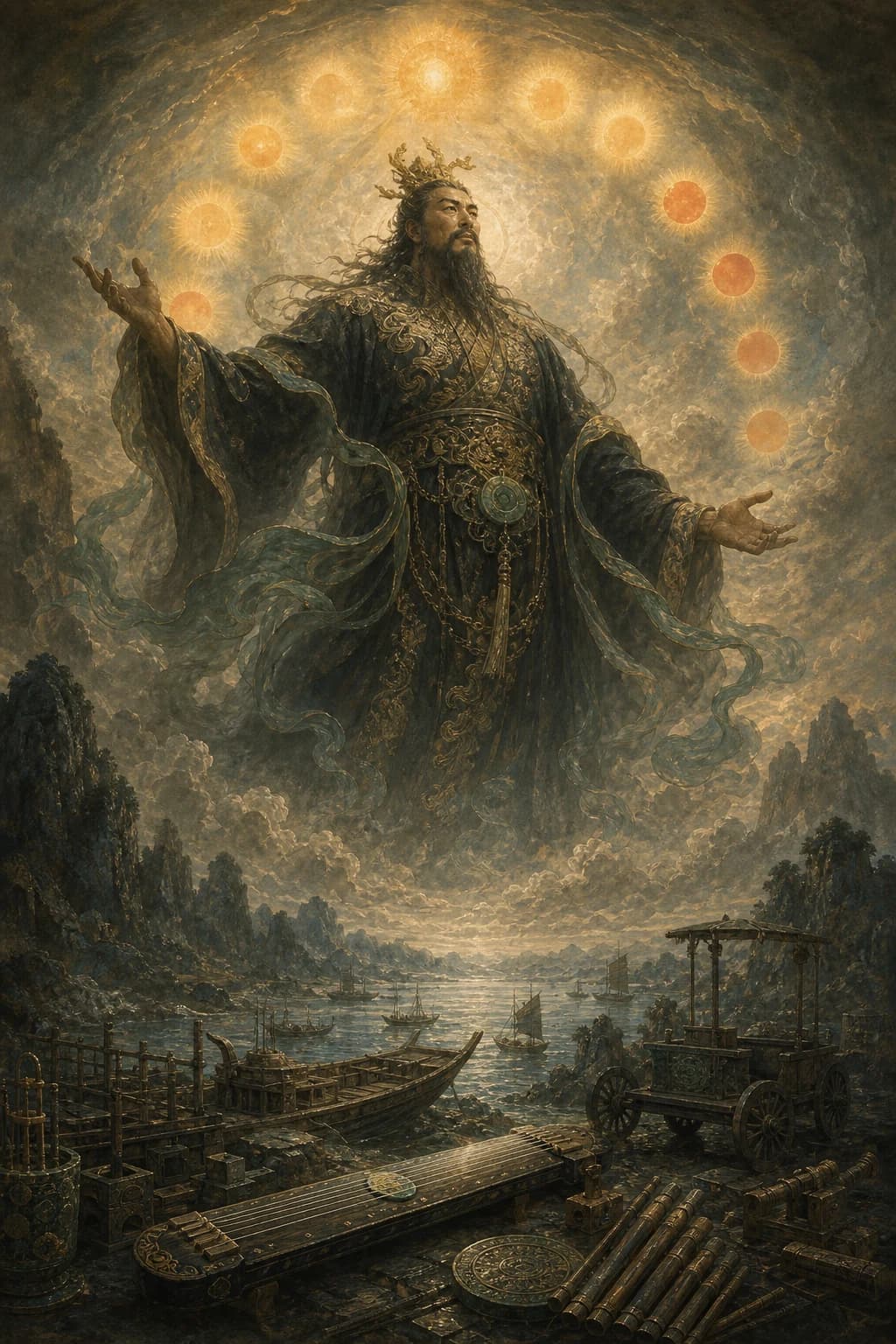
The final chapter grafts the nation into the lineage of invention: Di Jun begat Three-Body, Three-Body begat Yijun, and Yijun — the craftsman Qiao Chui — first devised the hundred crafts for the people below. A nation of prodigious anatomy is thus also an ancestor of technology; in this book, strange bodies and noble arts descend together.