THE STORY & ITS AFTERLIVES
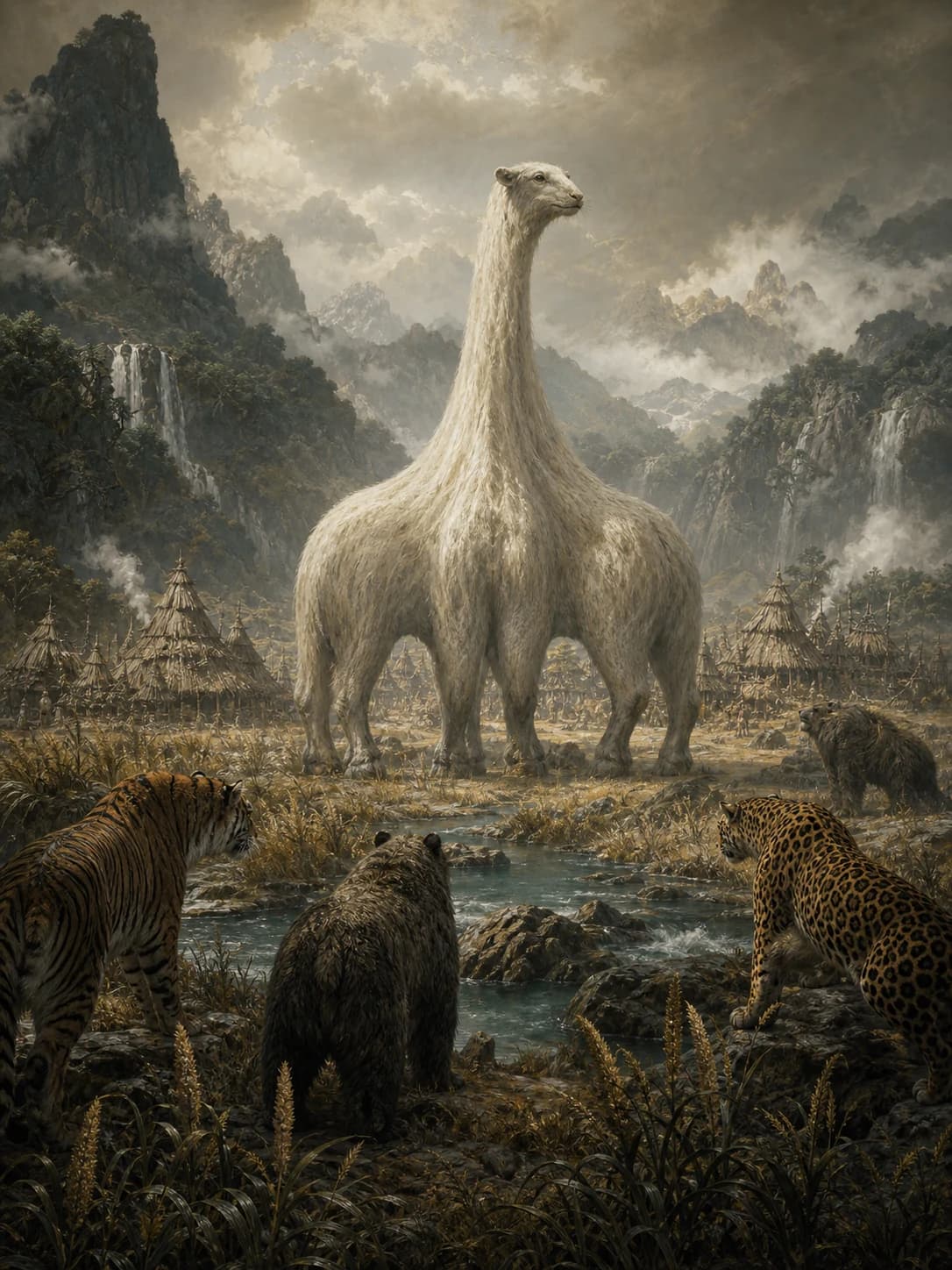
The Country of Wuxian lies north of the corpse of Nüchou, says the Beyond the Seas: West chapter; its people hold a green snake in the right hand and a red snake in the left. In the country rises Mount Dengbao, 'whence the assembled shamans ascend and descend' — a ladder between earth and heaven. Gripping snakes is regalia shared by gods and shamans throughout the Classic; here, one color to each hand is the national dress.
The Great Wilderness: West records a parallel institution on Mount Ling, where ten shamans — Wuxian, Wuji, Wufen, Wupeng, Wugu, Wuzhen, Wuli, Wudi, Wuxie, Wuluo — 'ascend and descend, and the hundred medicines are found there.' The archaic shaman worked both jobs at once: climbing to heaven to speak with spirits and gathering herbs to heal the sick. No passage preserves the early unity of shaman and physician more completely.
Wuxian himself is a famous name in transmitted literature. The Book of Documents has him steadying the royal house under the Shang king Taiwu; the Shiben credits him with inventing yarrow divination; and in the Li Sao it is Wuxian who 'descends at dusk' while the poet waits with offerings of pepper and rice for an oracle. A Shang minister, a divining art, an overseas nation, and a mountain of medicines all gather under one name: the Country of Wuxian is the ancient shamans' guild projected onto the map of the world.