THE STORY & ITS AFTERLIVES
Peris are the winged spirits of Persian legend, imagined most often as women of surpassing beauty who haunt gardens, springs, and the edges of clouds. Their ancestry is far less lovely: the pairikas of the Avesta are witch-spirits in the service of darkness, seduction their weapon — scripture names the pairika Duzhyairya, "bad harvest," and the star hymns speak of pairikas disguised as shooting stars to disorder the sky. In Zoroastrian reckoning they belong with the divs among the beings to be exorcised by prayer.
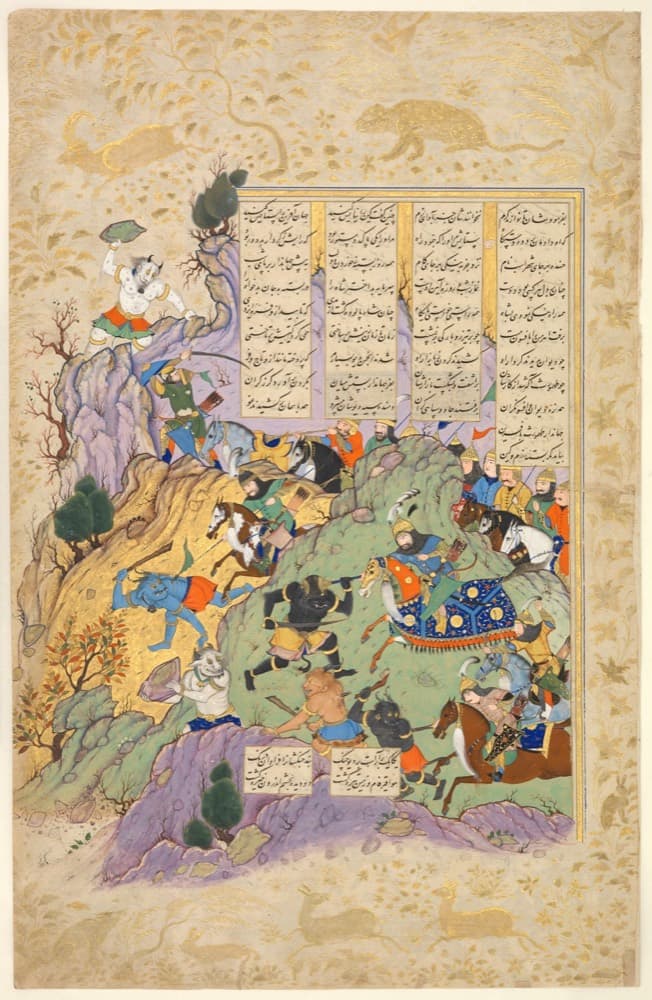
In the Islamic centuries the peri turned from witch to fairy in Persian literature and folktale. They became an airy race living on fragrance, ranked between angels and mankind, perennial enemies of the brutish divs — story after story has a peri carried off and locked in an iron cage by a div until a hero frees her, and winning a peri bride is a standard crown of heroic adventure in Persian and Turkic oral epic. Pari-chehr, "peri-faced," and pari-zad, "peri-born," became stock Persian terms for human beauty, the latter surviving as a personal name. The word traveled west with literature: in Thomas Moore's Lalla Rookh (1817), the poem "Paradise and the Peri" tells of a peri barred from heaven who wins readmission with three gifts; it swept Europe, Schumann set it as an oratorio in 1843, and the peri entered English dictionaries as the fixed image of the Oriental fairy.