THE STORY & ITS AFTERLIVES
The leprechaun is the solitary among Irish fairies, keeping apart from the trooping si-folk, living alone in the wild and working as cobbler to the fairy kind, who are said to wear out their shoes with nightly dancing. He appears as an old man somewhere between a hand's span and knee height, in a leather apron, pipe in mouth, betrayed by the tap-tap of his hammer. His fame rests on buried crocks of gold: hold him in your gaze without blinking and he must buy his freedom with treasure or three wishes, but he always contrives to make you look away, the classic trick being a cry of 'behind you!', and in that blink he is gone. In another well-worn tale a man marks the ragwort over the treasure with a red garter and goes for a spade, only to return and find every ragwort in the field wearing one.
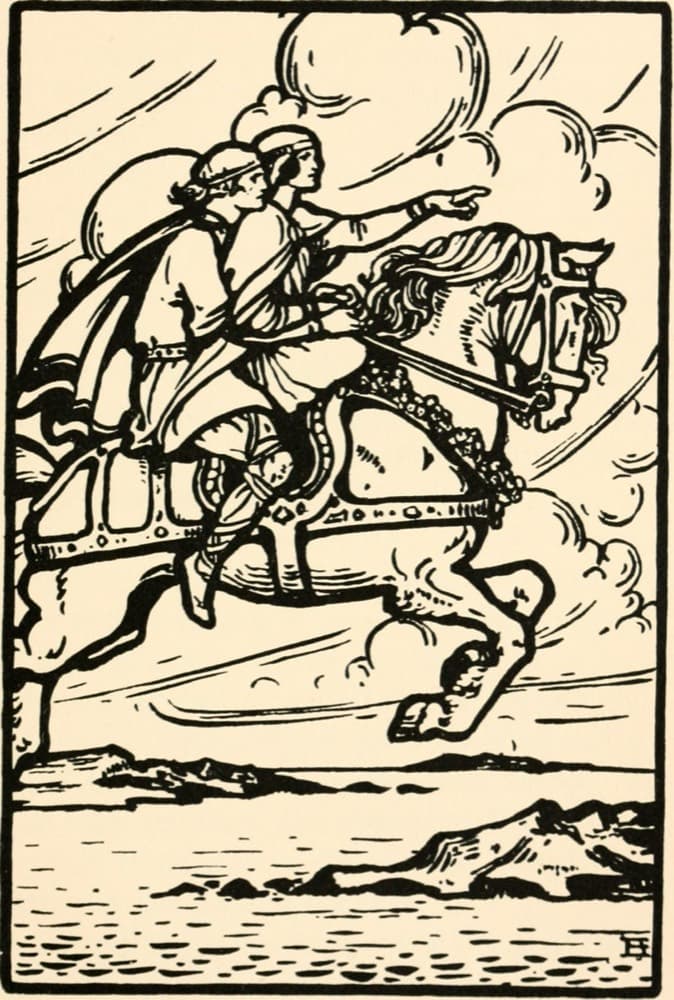
The written trail begins with the eighth-century saga Echtra Fergusa maic Leti, in which King Fergus of Ulster, asleep on the shore, is carried toward the sea by luchorpain, 'small bodies', water sprites from whom he wins the power to travel under water. How the medieval water-dwarf became the modern land-bound cobbler is not fully documented. Thomas Crofton Croker's 1825 collection records his Munster cousin the cluricaune, a tippling cellar-haunter, and W. B. Yeats classed the leprechaun among the 'solitary fairies' in his 1888 anthology of Irish peasant tales.
Since the nineteenth century the green coat, red beard, crock of gold and rainbow's end have multiplied through emigrant culture and advertising into a global shorthand for Irishness, a cartoon that Irish folklorists regard with limited enthusiasm.