THE STORY & ITS AFTERLIVES
Kali presents one of the most arresting images in Hindu myth: skin black as midnight, hair unbound, a scarlet tongue lolling from her mouth, a garland of fifty severed heads at her neck and a skirt of severed arms at her waist. Two of her four hands hold a curved sword and a dripping head; the other two form gestures of protection and blessing. Beneath her feet lies Shiva—in the usual telling, her battle frenzy became a dance that threatened to shatter the earth, so Shiva lay down in her path; recognizing her husband underfoot, she stopped short, tongue thrust out.
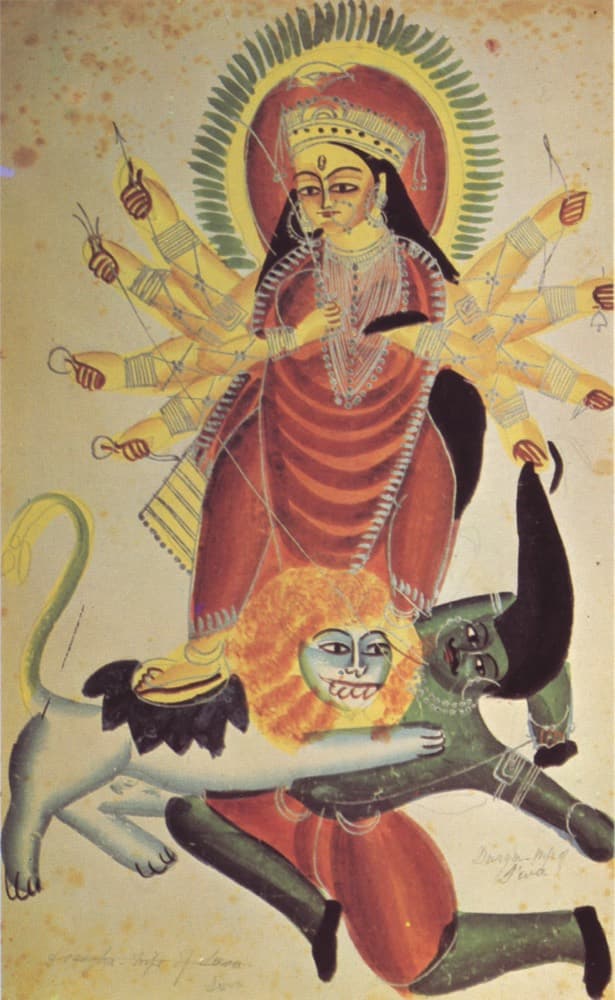
Her charter myth is the Devi Mahatmya (c. 5th–6th century CE, within the Markandeya Purana): as Durga faced the demon armies, Kali sprang from her furrowed brow and devoured the ranks. Her most famous duel was with Raktabija, the 'blood-seed' demon, each drop of whose spilled blood spawned a duplicate. Where the gods failed, Kali caught every drop on her tongue and drained the demon and his clones dry.
Her worship is strongest in Bengal. The Kalighat temple—by one account the source of Calcutta's name—is counted among the sites where the body of the goddess Sati fell to earth; Kali Puja, held around Diwali each autumn, is one of the region's great festivals. The devotion of the 19th-century saint Ramakrishna at the Dakshineswar temple fixed her modern image: the terrifying face of a fiercely protective mother.