THE STORY & ITS AFTERLIVES
The Book of Jonah opens with the Lord commanding Jonah son of Amittai to go to Nineveh, the great Assyrian city, and cry out against its wickedness. Jonah instead rises to flee to Tarshish, in the opposite direction: down to the port of Joppa, fare paid, aboard ship. The Lord hurls a great wind on the sea; the ship threatens to break apart, the sailors cry each to his own god and throw the cargo overboard, while Jonah sleeps in the hold. The lot falls on him; he confesses that he fears the God of heaven who made the sea and the dry land, and tells them to throw him in — the sea will grow calm. The sailors row hard rather than do it, then at last cast him over, and the raging stops.
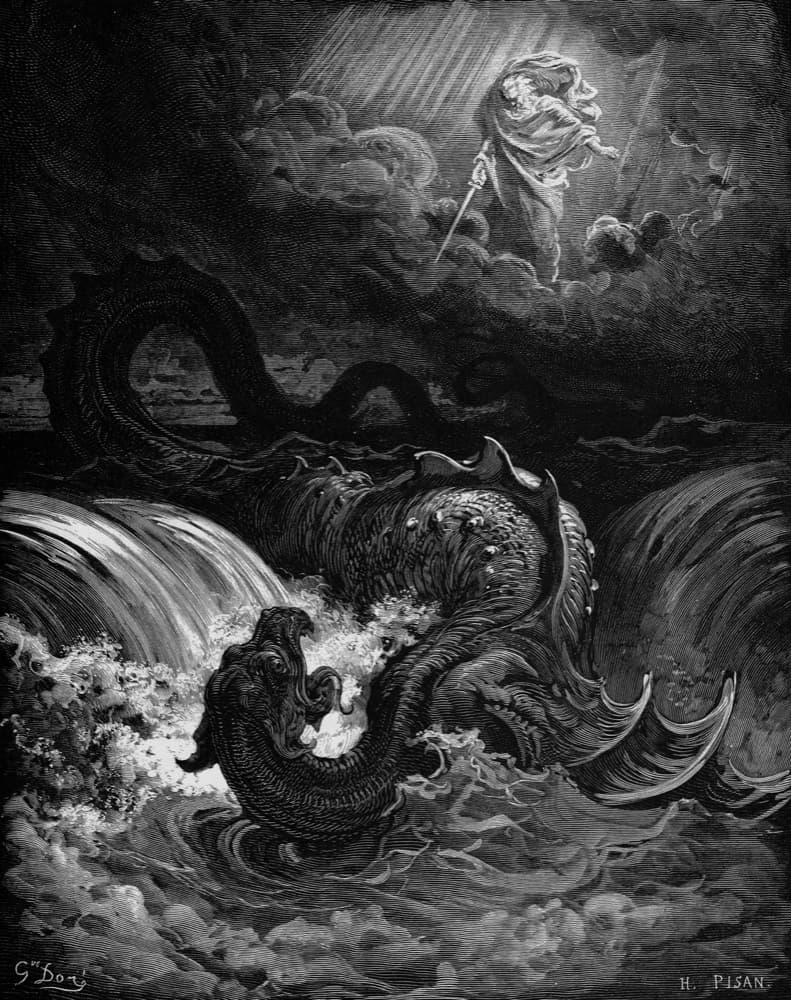
The Lord appoints a great fish — the text says only dag gadol, never 'whale' — to swallow Jonah, and from its belly, three days and three nights, he prays 'out of the belly of Sheol': the waters closed in over me, weeds were wrapped about my head, yet I shall look again upon your holy temple. The Lord speaks to the fish, and it vomits Jonah onto dry land. Commissioned a second time, he walks into Nineveh proclaiming: forty days more, and Nineveh shall be overthrown. Astonishingly, the whole city repents in sackcloth and ashes, from king to commoner, and God relents. Jonah is furious; he sits east of the city to watch, where God grows a qiqayon plant overnight to shade him and appoints a worm to kill it at dawn, then asks: you pity the plant that came up in a night — should I not pity that great city, with more than 120,000 people who cannot tell their right hand from their left? The book ends on the question.
Matthew 12 cites the 'sign of Jonah,' the three days in the fish prefiguring burial and resurrection, which made Jonah a favorite subject of early Christian catacomb painting. The Quran calls him Yunus, 'the man of the fish' (Dhu al-Nun), and recounts his swallowing and rescue in sura 37. The Mosque of the Prophet Yunus in Mosul, Iraq, traditionally held to house his tomb at Nineveh, was blown up by extremists in 2014; the ruins exposed remains of an Assyrian palace beneath.