THE STORY & ITS AFTERLIVES
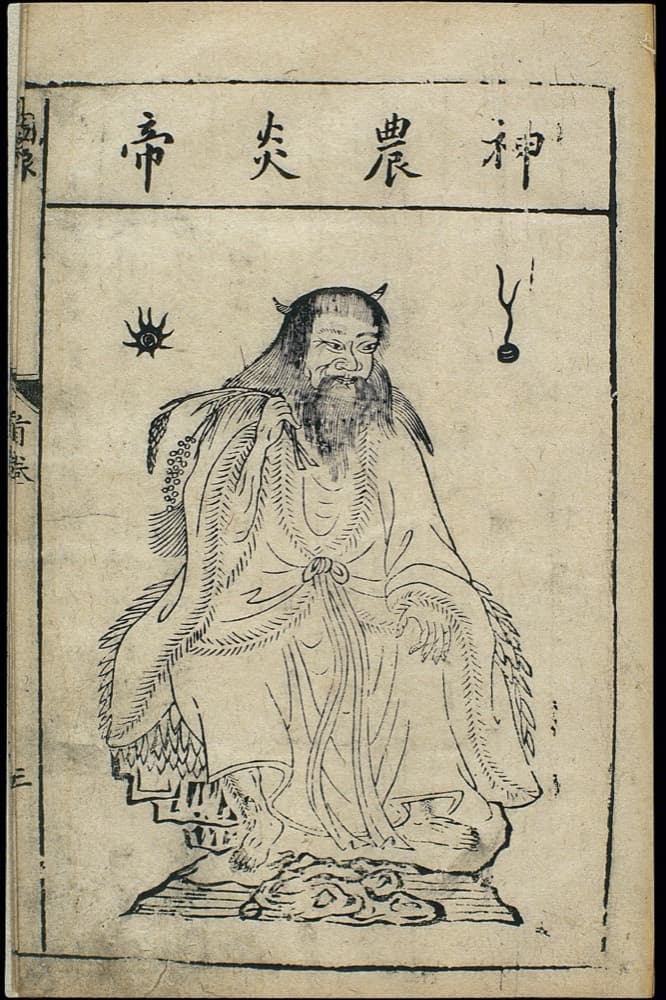
On Fajiu Mountain in the third guideway of the Northern Mountains grows a forest of wild mulberry, and in it lives a bird shaped like a crow, with a patterned head, a white beak, and red feet; its cry sounds like it is calling its own name, jingwei. The classic then gives the bird a biography, rare in a book of terse catalogue entries: she was once a girl called Nüwa — written with different characters from the creator goddess whose name romanizes the same way — the youngest daughter of the Flame Emperor Yandi. Swimming in the Eastern Sea, she drowned and never returned, and so became the jingwei, which forever carries twigs and stones from the Western Mountains in its beak and drops them into the Eastern Sea, trying to fill it in.
The story became one of the most quoted passages of the entire classic. The poet Tao Yuanming, writing around 400 CE, paired the bird with the headless rebel Xingtian in his cycle 'Reading the Classic of Mountains and Seas': 'Jingwei carries slivers of wood to dam the boundless sea.' Ren Fang's sixth-century Shuyiji records the folk names the bird had accumulated: the Wronged Bird, the Oath Bird, the Resolute Bird, or simply the Emperor's Daughter Sparrow, said to have sworn never to drink the water that killed her.
The phrase 'Jingwei fills the sea' hardened into a proverb for unyielding effort against impossible odds. Fajiu Mountain is a real place in Zhangzi County, Shanxi, at the source of the Zhuozhang River, where a temple to Jingwei once stood.