THE STORY & ITS AFTERLIVES
The Great Sphinx crouches beside the causeway of Khafre's pyramid on the Giza plateau: about 73 meters long and 20 meters high, cut from the living limestone bedrock, the oldest colossal statue in existence. The body is a recumbent lion; the human head wears the striped nemes headcloth and once bore a uraeus, and the face is generally identified as Khafre, fourth king of the Fourth Dynasty (r. c. 2558–2532 BCE), during whose pyramid works the statue was carved. In Egyptian iconography the lion-king composite fuses solar power with royal authority — and unlike the riddling, man-eating female sphinx of Greek myth, the Egyptian sphinx is male and protective; even the name 'sphinx' is a later Greek label.
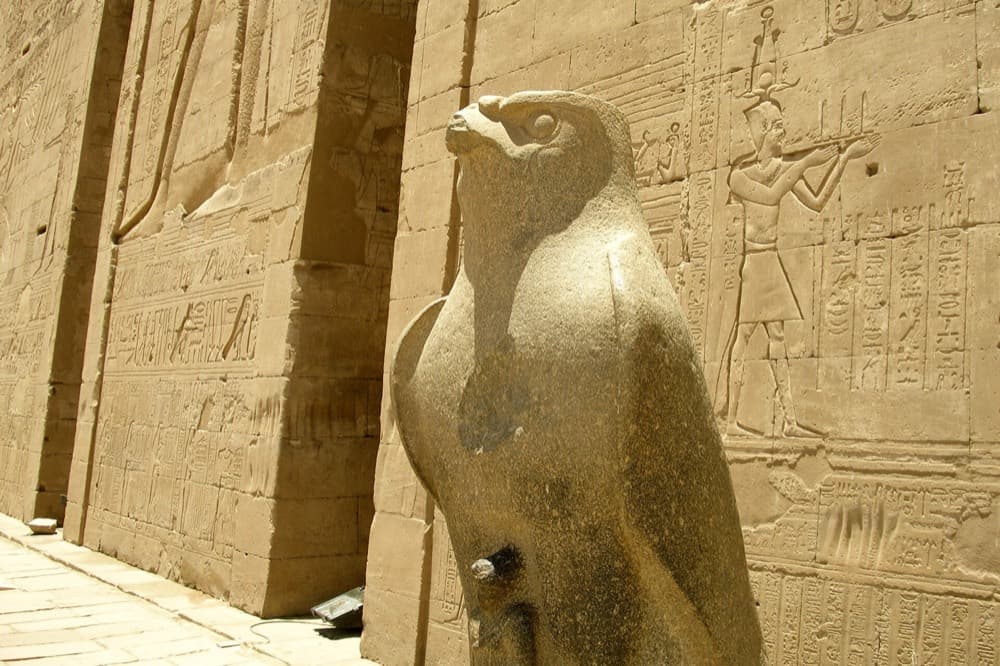
In the New Kingdom the half-buried colossus acquired a cult of its own as Horemakhet, 'Horus in the Horizon,' and drew pilgrims. The Dream Stele standing between its paws tells how prince Thutmose, napping in the statue's shadow during a hunt, dreamed that the Sphinx spoke and promised him the throne if he cleared away the engulfing sand; as Thutmose IV (r. c. 1400 BCE) he erected the granite stele in fulfillment, and it remains in place.
The nose was already gone in the Middle Ages — the fifteenth-century Cairo historian al-Maqrizi blames a Sufi zealot in 1378 — and the tale of Napoleonic cannon fire is a later invention, since mid-eighteenth-century drawings show the nose missing. Sand has buried and re-buried the monument repeatedly; the last full clearance was completed in 1936.