THE STORY & ITS AFTERLIVES
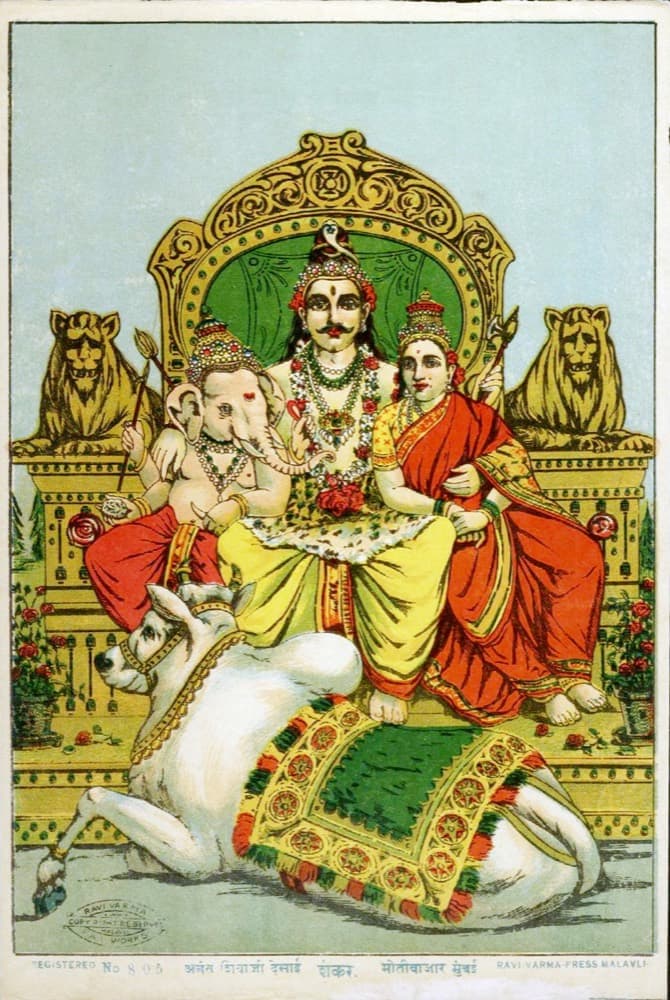
Ganesha has the head of an elephant on a boy's plump body: winnowing-fan ears, one tusk broken, a serpent knotted about his round belly, four hands holding an axe, a noose, the broken tusk and a bowl of modak sweets. His mount is a mouse named Mushika. God of wisdom, letters and commerce, he bears the title Vighneshvara, Lord of Obstacles—he who places them and, above all, removes them, which is why Hindus invoke him before any undertaking.
The Shiva Purana tells of his origin: Parvati shaped a boy from the paste of her own body and set him to guard her bath. Shiva, barred from his own door by the stranger, struck off the boy's head in fury. To calm Parvati's grief he had his attendants bring the head of the first creature they met—an elephant—and set it on the child's neck, making him chief of his attendant host, the ganas; hence the name Ganesha, Lord of the Ganas. Of the broken tusk many stories are told; the most repeated has Ganesha snapping it off to serve as a pen when the sage Vyasa dictated the hundred-thousand-verse Mahabharata without pause.
Ganesh Chaturthi, in August or September, reaches its height in Maharashtra: households and street associations install clay images of the god and, after ten days, carry them in procession to be immersed in the sea or a river—in Mumbai alone the immersions number in the hundreds of thousands. Ganesha travelled east with Hinduism and Buddhism, entering Chinese Buddhist texts as Huanxitian, the elephant-trunked deva.