THE STORY & ITS AFTERLIVES
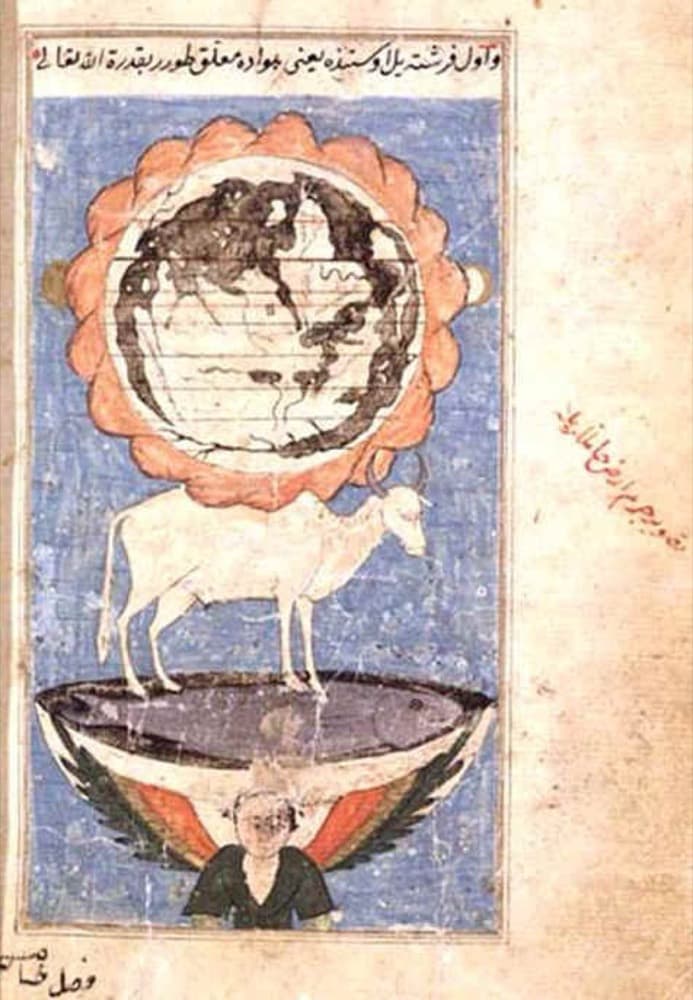
In the layered world-picture of medieval Arab cosmography, Bahamut lies at the bottom of everything. When the earth was created it swayed, so God sent an angel to bear it up; the angel needed footing, so a rock of gem was set beneath him; under the rock stands a colossal bull, often called Kuyutha, with uncounted eyes and horns; and the bull stands on the back of a fish — Bahamut. Beneath the fish is water, beneath the water wind, beneath the wind darkness, and there human knowledge ends. Cosmographies such as al-Qazwini's thirteenth-century Wonders of Creation record the scheme, along with a famous measure of the fish's size: all the seas of the world, set in one of its nostrils, would be as a mustard seed in a desert.
The name descends from the Hebrew Behemoth, the land beast of the Book of Job, which in Arabic tradition became a fish of the abyss — trading elements, as it were, with the watery Leviathan. In Burton's English translation of the Thousand and One Nights, the 496th night grants Isa (Jesus) a vision of Bahamut; he falls senseless for three days.
Borges gave the fish an entry in The Book of Imaginary Beings, reading the tower of angel, rock, bull and fish as a figure for the infinite regress of causes. Modern fantasy rebuilt the creature entirely: Dungeons and Dragons crowned Bahamut a platinum dragon god, Final Fantasy made him the king of summoned dragons, and the silent back that carries the world in the old texts is now the least-known thing about him.