THE STORY & ITS AFTERLIVES
Aztlan is the legendary homeland of the Mexica: a white island in a lake, its name usually read as Place of the Herons or Place of Whiteness. In the tales life there was easy — people paddled canoes among the reeds, fished, tended gardens, and did not grow old. From it comes the word Aztec, from Aztecah, "people from Aztlan"; the people themselves said Mexica, and "Aztec" became the common label only in the nineteenth century through the works of Humboldt and Prescott.
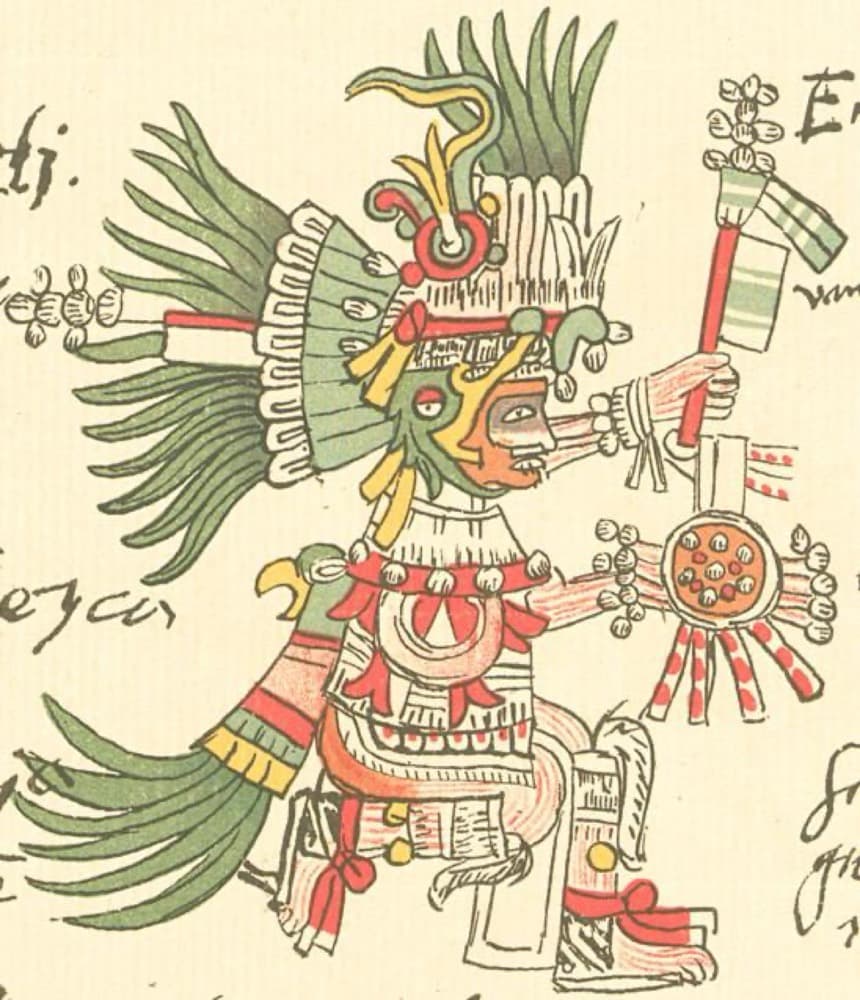
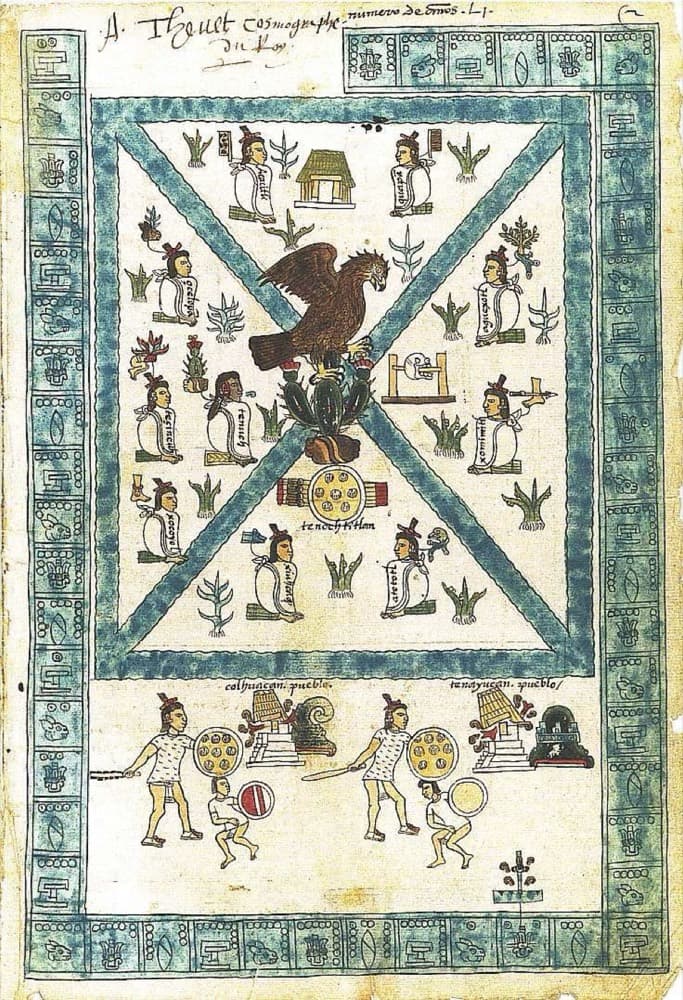
Migration lore holds that the patron god Huitzilopochtli ordered his people out of Aztlan, his effigy borne ahead by priests who relayed his commands. Tradition fixes the departure in a year 1 Flint, which scholars correlate to 1064 or 1168 CE. On the road the migrants passed through Chicomoztoc, the Place of Seven Caves — in some accounts another name for Aztlan or a sanctuary beside it — from which all the Nahua peoples claimed descent. After some two centuries of wandering, the Mexica saw the promised eagle on a cactus in Lake Texcoco and founded Tenochtitlan. The opening page of the Codex Boturini, the Strip of the Pilgrimage, shows the leaving itself: a lone figure paddling from the island while Huitzilopochtli speaks from a shrine on the shore.
Durán records that at the empire's height Moctezuma I sent sixty sorcerers north with rich gifts to find the ancestral land; they reached a lake and a hill where no one aged, and met the god's ancient mother. No real location has ever been established — candidates run from northwest Mexico to the American Southwest, the ring-shaped island town of Mexcaltitán in Nayarit being the most celebrated for its resemblance to the codex image. In the twentieth century Aztlán was taken up again as a cultural emblem of the Chicano movement in the United States.