THE STORY & ITS AFTERLIVES
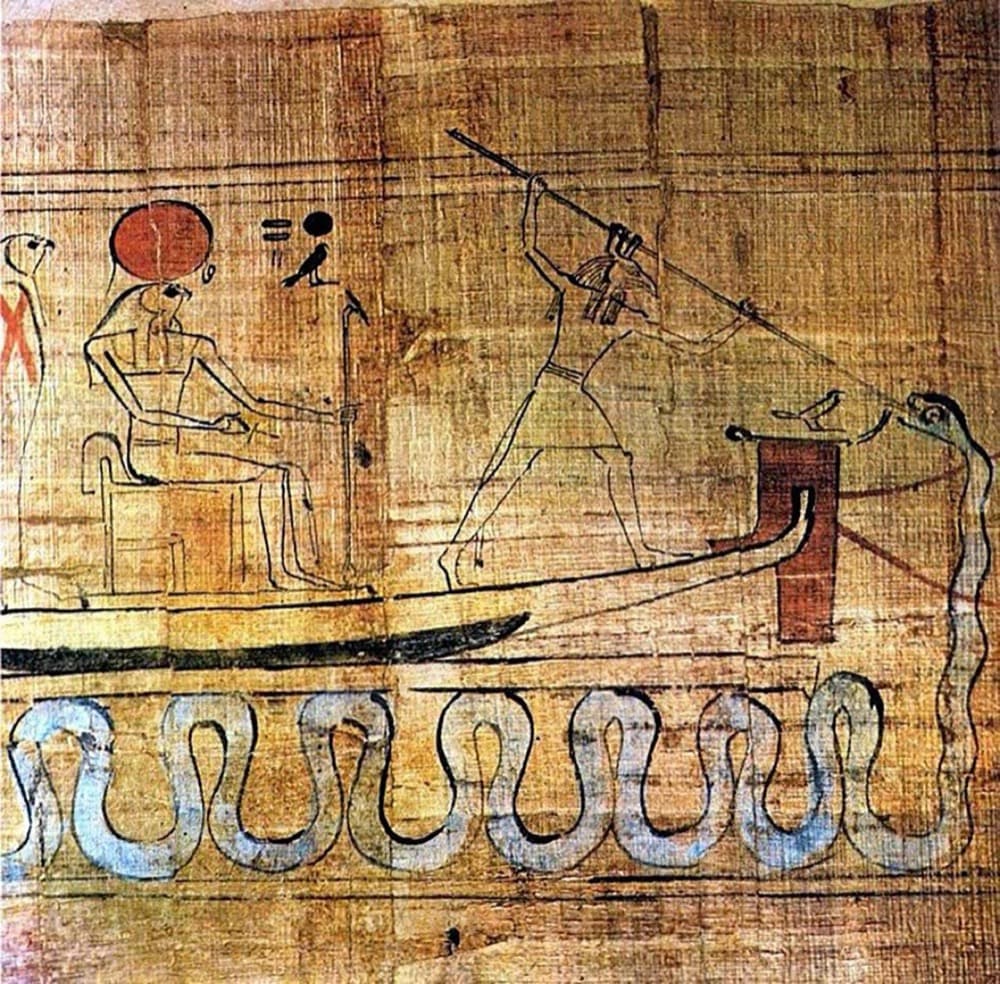
Apep is a colossal coiled serpent; in the illustrated netherworld books his body winds across entire registers, sometimes shown hacked into segments that still writhe. He embodies isfet, the chaos and non-being opposed to the order of maat. First attested in Middle Kingdom sources, he thereafter occupies the center of Egyptian ideas of the beyond: each night, as the sun crosses the Duat, Apep waits on the sandbanks, transfixes the crew of the barque with his hypnotic stare, and tries to drink the river dry and swallow the sun. Set spears him from the prow while other gods bind him with ropes and carve him with knives — and the next night he is whole again. Eclipses and storms were read as moments when Apep briefly succeeded.
He is a rarity in the Egyptian pantheon: an entity of pure enmity, with no temple, no priesthood, no offerings — only execration. The Book of Overthrowing Apep, preserved in Papyrus Bremner-Rhind (a copy of about the fourth century BCE, now in the British Museum), records the daily temple rite: an image of the serpent was modeled in wax, inscribed with his name, spat upon, trampled, pierced with a spear, and burned, to speed the solar barque safely on.
In the Hellenistic period his name was rendered Apophis, and modern astronomy borrowed it for near-Earth asteroid 99942, discovered in 2004, which will pass close by Earth in 2029.