THE STORY & ITS AFTERLIVES
The name Amun means 'the Hidden One' — a god imperceptible as wind and breath. His standard image is a man wearing a crown of two tall plumes, his skin often painted blue; his sacred animals are the curl-horned ram and the goose, and ram-headed sphinxes still line the processional way at Karnak. He appears as early as the Pyramid Texts, and in the theology of Hermopolis he and his consort Amaunet belonged to the Ogdoad, the eight powers of the precreation chaos.
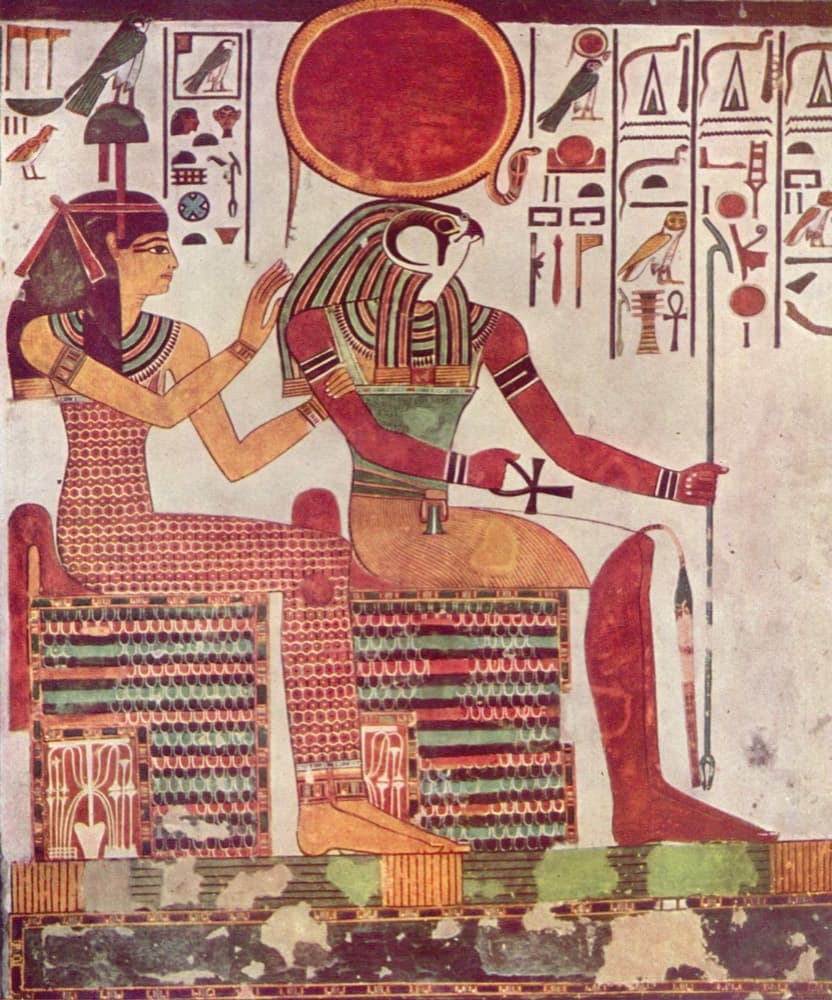
His rise tracked the fortunes of Thebes. When the city produced the ruling houses of the Middle Kingdom, its local god rose with it; in the New Kingdom he merged with the sun god as Amun-Ra, 'king of the gods' and state deity of the empire. His temple complex at Karnak, enlarged by pharaohs for nearly two thousand years, covers more than a hundred hectares and is the largest religious precinct of the ancient world; the tallest of the 134 columns in its hypostyle hall rise to 21 meters. The wealth of his priesthood grew to rival the crown's. Akhenaten's revolution began by hammering out Amun's name, and its collapse only entrenched the god further. The Great Hymn in Papyrus Leiden I 350 declares all gods to be his manifestations, the closest Egyptian theology came to a unitary conception of deity.
His oracle at the Siwa oasis deep in the Libyan desert was famous across the Mediterranean; in 331 BCE Alexander the Great crossed the sands to consult it and was hailed as the son of Amun; after his death, coin portraits struck by his successors showed him wearing the god's ram horns.