THE STORY & ITS AFTERLIVES
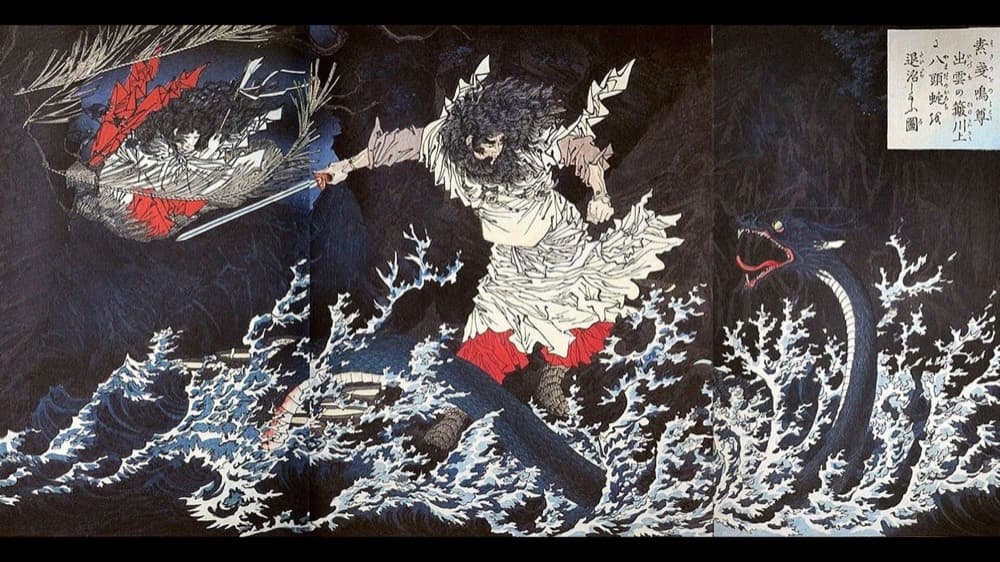
The Kojiki puts the description in the mouth of the old man Ashinazuchi: eyes red as winter cherries, one body bearing eight heads and eight tails, moss and cypress and cedar sprouting from its back, a bulk stretching over eight valleys and eight ridges, its belly perpetually raw with blood. The monster haunted the upper Hii River in Izumo and came down once a year to devour one of the old couple's daughters; seven were gone, and only the youngest, Kushinada-hime, remained.
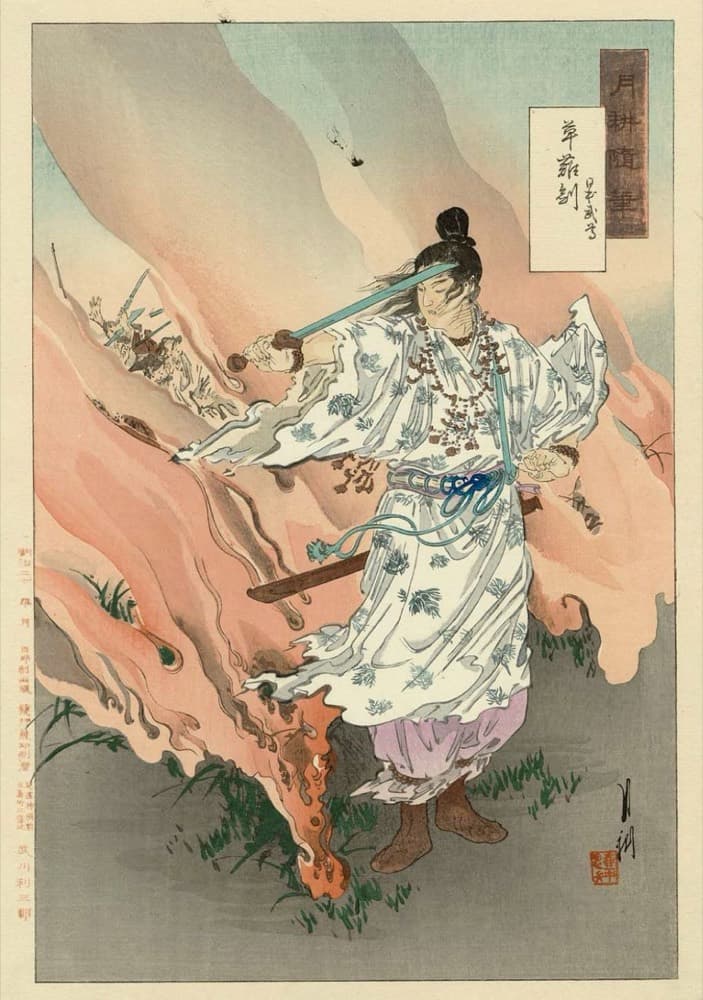
Susanoo, newly banished from heaven, arrived at Torikami at just that moment. Turning the girl into a comb that he thrust into his hair, he had the couple brew eightfold-refined sake and build a fence with eight gates, a brimming vat behind each. The serpent came, dipped each of its eight heads into a vat, drank itself senseless, and sprawled asleep. Susanoo cut it to pieces with his ten-span sword until the Hii River ran red. At the middle tail his blade chipped; splitting the flesh he drew out a great sword, Ame-no-Murakumo, later called Kusanagi, one of the three imperial regalia, so named by tradition because clouds always hung above the serpent.
Scholars have read the myth as an image of the flooding Hii or of iron-sand smelting that reddened its waters. On stage the monster survives: the Iwami kagura piece Orochi, with its coiling, smoke-breathing serpents, remains the region's showstopper.