THE STORY & ITS AFTERLIVES
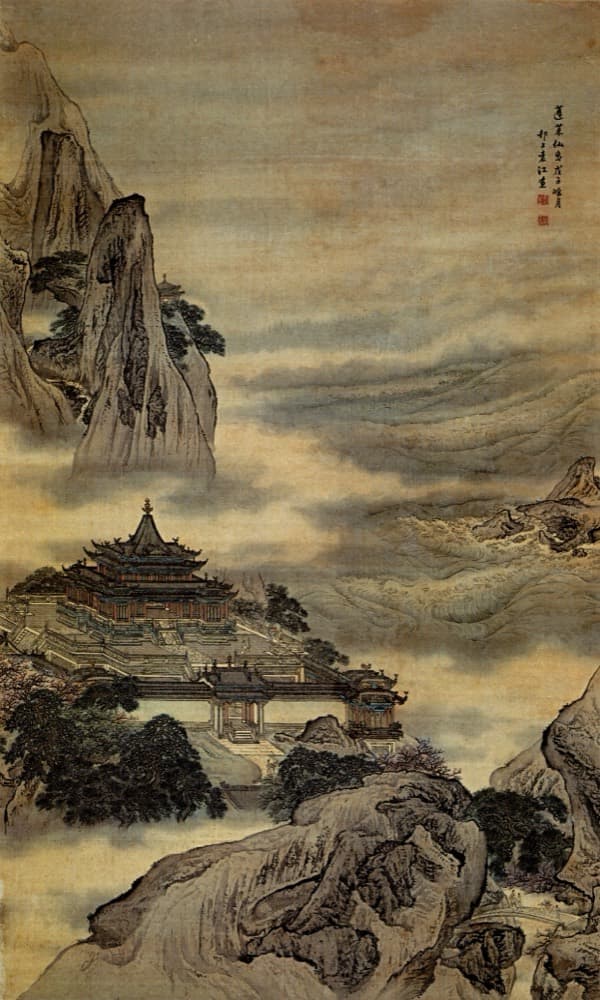
The Peach Blossom Spring comes from a prose piece written around 421 by the Eastern Jin poet Tao Yuanming. During the Taiyuan era, a fisherman of Wuling followed a stream and came upon a grove of blossoming peach trees lining both banks for hundreds of paces, petals drifting over fresh grass. Where the grove ended at the stream's source stood a hill with a small opening; leaving his boat, he squeezed through a passage that widened suddenly onto level fields, trim houses, fine paddies, ponds, mulberry, and bamboo, where the old and the young alike were at ease. The villagers said their ancestors had fled the turmoil of Qin and never left; they had not heard of the Han dynasty, let alone the Wei or Jin. Leaving after several days, the fisherman was told the place was not worth mentioning to outsiders. He marked the route, reported to the prefect, and guides were sent, but the marks led nowhere. The recluse Liu Ziji of Nanyang planned his own search, died before setting out, and no one asked the way again.
Writing amid the wars of the Jin-Song transition, Tao compressed into under four hundred characters a vision of a self-governing countryside without taxes or soldiers. Liu Ziji was a real man, listed among the recluses in the Book of Jin, and this splice of fact into fiction kept later readers half-believing. Wang Wei, Han Yu, and Liu Yuxi wrote famous poems on the theme; "a Peach Blossom Spring beyond the world" became a fixed idiom; and Taoyuan county in Hunan takes its name from the tale, its riverside shrine complex accreting since the Tang. Unlike most lost lands, it was fiction from the first line, yet it became the root image of every hidden utopia in Chinese.