THE STORY & ITS AFTERLIVES
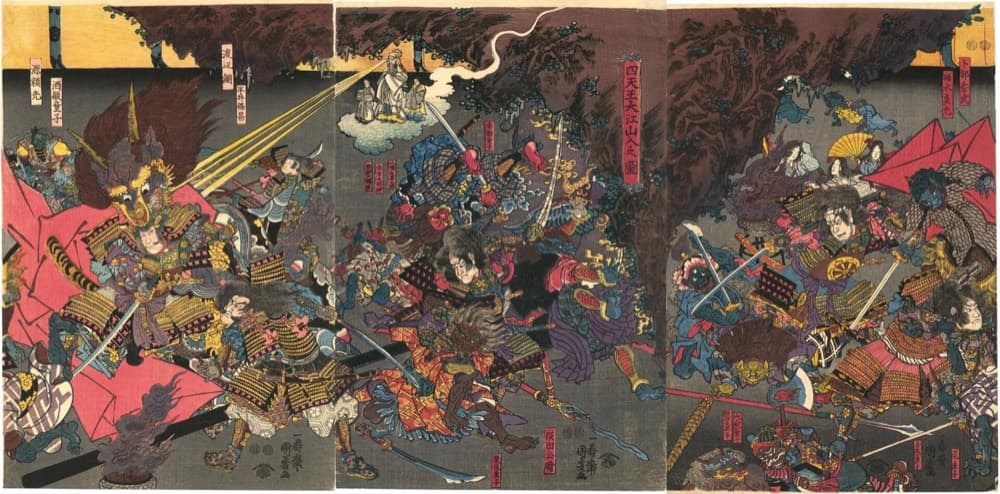
The Muromachi-period tale Tamamo no Soshi tells the story. At the court of Retired Emperor Toba lived a favorite of matchless beauty and learning called Tamamo no Mae, whose body gave off a strange fragrance and was said to glow in the dark. The emperor sickened, and no medicine availed, until the diviner Abe no Yasunari traced the illness to the lady herself: she was a fox of great age. Forced to reveal her true shape during a rite of exorcism, she fled the palace as a white fox and made for the Nasu moor in the east.
The court sent the warriors Kazusa-no-suke and Miura-no-suke with a great host. Legend has them first perfecting their mounted archery by shooting at running dogs, an origin claimed for the inuoumono exercise, before they brought the fox down on the plain. Her malice congealed into a boulder that killed every bird and beast that came near, the Sessho-seki or Killing Stone. In the fourteenth century the Zen monk Genno shattered it with his staff and released the spirit, which is why a heavy hammer is still called a genno in Japanese; the noh play Sessho-seki stages the stone confessing its past to a traveling priest.
Early texts give the fox two tails; Edo-period fiction, culminating in Takai Ranzan's Ehon Sangoku Yofuden (1803-05), rewrote her as the nine-tailed fox who had ruined courts in India and China as Lady Kayo and Daji before crossing to Japan. The stone still stands among the sulfur vents of Nasu, and its natural splitting in March 2022 made national news.