THE STORY & ITS AFTERLIVES
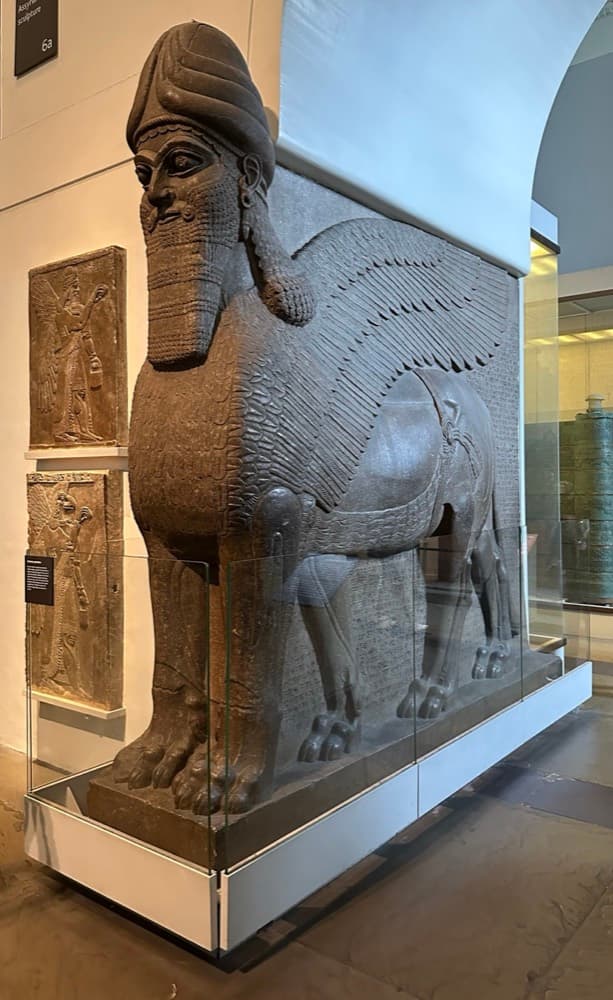
Pazuzu is the king of the wind demons, son of Hanbi, a fixture of Assyrian and Babylonian exorcism in the first millennium BCE. His body is assembled from menacing parts: a dog-lion face with bulging eyes, a scaled torso, four wings, taloned bird feet, a scorpion's tail, one hand raised and one lowered. A bronze statuette in the Louvre, about fifteen centimeters tall and of roughly the seventh century BCE, carries his self-introduction on the back: 'I am Pazuzu, son of Hanbi, king of the evil wind demons, who comes down raging from the quaking mountains.'
Mesopotamians fought fire with fire. Though he personified the scorching, dust-laden winds, his fearsomeness outranked that of other demons, so he was recruited as a protector: pregnant women and new mothers wore his small head as an amulet to scare off Lamashtu, the lion-headed demoness who preyed on mothers and infants. On bronze apotropaic plaques such as the Lamashtu plaque in the Louvre, Pazuzu's head peers over the top edge while the scene below shows Lamashtu driven back to the netherworld. His head-pendants, in bronze, stone, and faience, have turned up from Mesopotamia across the Levant and as far as the island of Samos.
The novel The Exorcist (1971) and its 1973 film cast him as the possessing demon — the prologue, filmed at the ruins of Hatra, has the old priest confront a Pazuzu statue — converting the ancient guardian demon into a modern icon of horror.