THE STORY & ITS AFTERLIVES
A creature of Mount Qingqiu
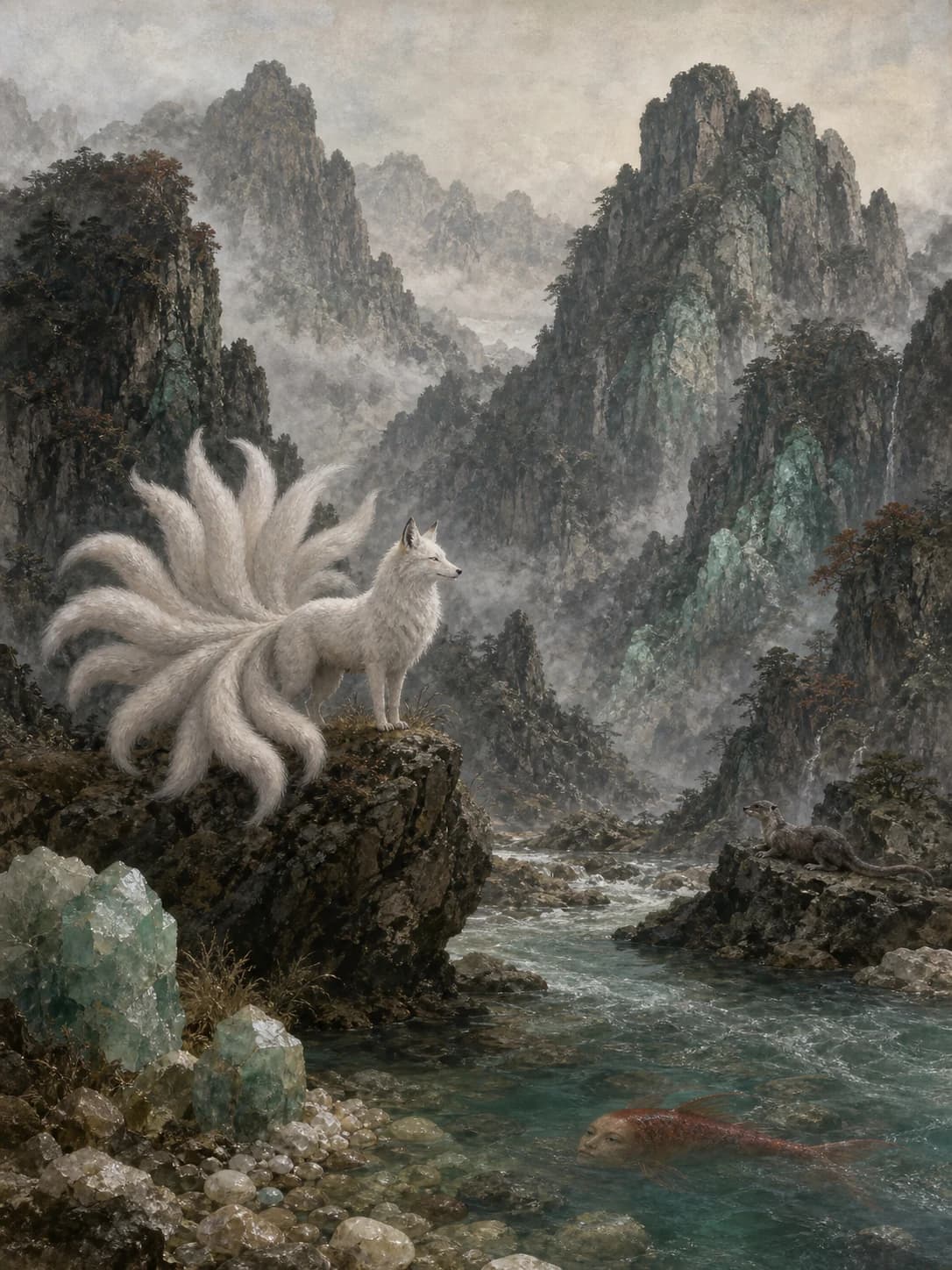
The Classic of the Southern Mountains gives it four terse clauses: on Mount Qingqiu lives a beast shaped like a fox with nine tails, its voice like that of a human infant; it can devour people, and whoever eats its flesh is proof against gu, the insect-borne witchcraft poison. The predator that lures with a baby's cry can itself be eaten as a talisman. Elsewhere in the book, the Classics of Regions Beyond the Seas and of the Great Wilderness record a Land of Qingqiu whose foxes have four legs and nine tails.
The auspicious fox
To Han-dynasty eyes the creature was auspicious. The Wu Yue Chunqiu tells how Yu the Great, still unmarried at thirty, saw a white nine-tailed fox at Mount Tushan and heard the local song 'the white fox roams, its nine tails full and thick', whereupon he took the daughter of Tushan as his wife. On Han pictorial stones the nine-tailed fox stands beside the Queen Mother of the West with the jade rabbit, the toad, and the three-legged crow, an emblem of abundant offspring and rightful rule.
Later transformations
From the Six Dynasties onward foxes turned demonic in the tale literature, and the Ming novel Investiture of the Gods sealed the type: a thousand-year fox spirit possesses Daji and ruins the Shang court. Later versions of Japan's Tamamo-no-Mae legend connect the fox with figures such as Daji; biographies and even tail counts need to be distinguished by text. Fiction, comics, and games continue to rework these fox stories.