THE STORY & ITS AFTERLIVES
Buyan is the mythical island of Russian incantations and wonder tales. The charms (zagovory) written down in the nineteenth century open with a fixed formula: "On the ocean-sea, on the island of Buyan..." Spells to stanch blood, drive off illness, protect a soldier or bind a lover all begin there, placing the source of their power on that island. Upon it stands the Alatyr, "father of all stones"; beneath or upon the stone the charms seat the Mother of God and the saints, or coil the king of serpents, and from it the force of every spell was believed to flow.
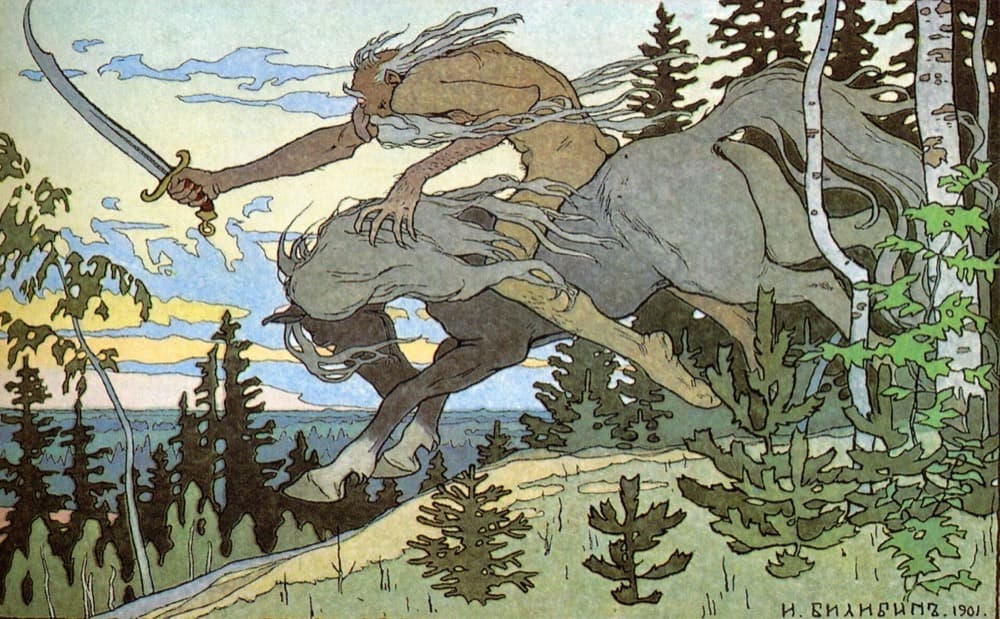
Some of the wonder tales lodge Koschei the Deathless's life on Buyan as well: in or under an oak lies a chest, in the chest a hare, in the hare a duck, in the duck an egg, and on the point of the needle inside the egg, his death. In 1831 Pushkin wrote the island into his verse Tale of Tsar Saltan, whose merchants sail "past the island of Buyan" toward the glorious tsar's realm; the recurring rhyme made Buyan a household name in the Russian-speaking world.
Its origin is unsettled. One school treats it as a pure verbal formula, the "centre of the world" of oral tradition; another links it with the Baltic island of Ruegen, where the temple of the West Slavic god Svetovit stood at Cape Arkona until Danish forces destroyed it in 1168. Neither side can produce decisive evidence.