THE STORY & ITS AFTERLIVES
The Classic of Regions Beyond the Seas: South spends exactly one clause on this country: its people have one body and three heads. The Huainanzi's catalogue of the thirty-six countries beyond the seas registers them as the Three-Headed Folk. Illustrated editions of the Shanhaijing across the centuries draw them as upright human figures with three heads set side by side on the shoulders, sometimes with three distinct expressions; commentators and colophon-writers amused themselves with the practical puzzles, whether three mouths share one hunger and whether three pairs of eyes share one mind.
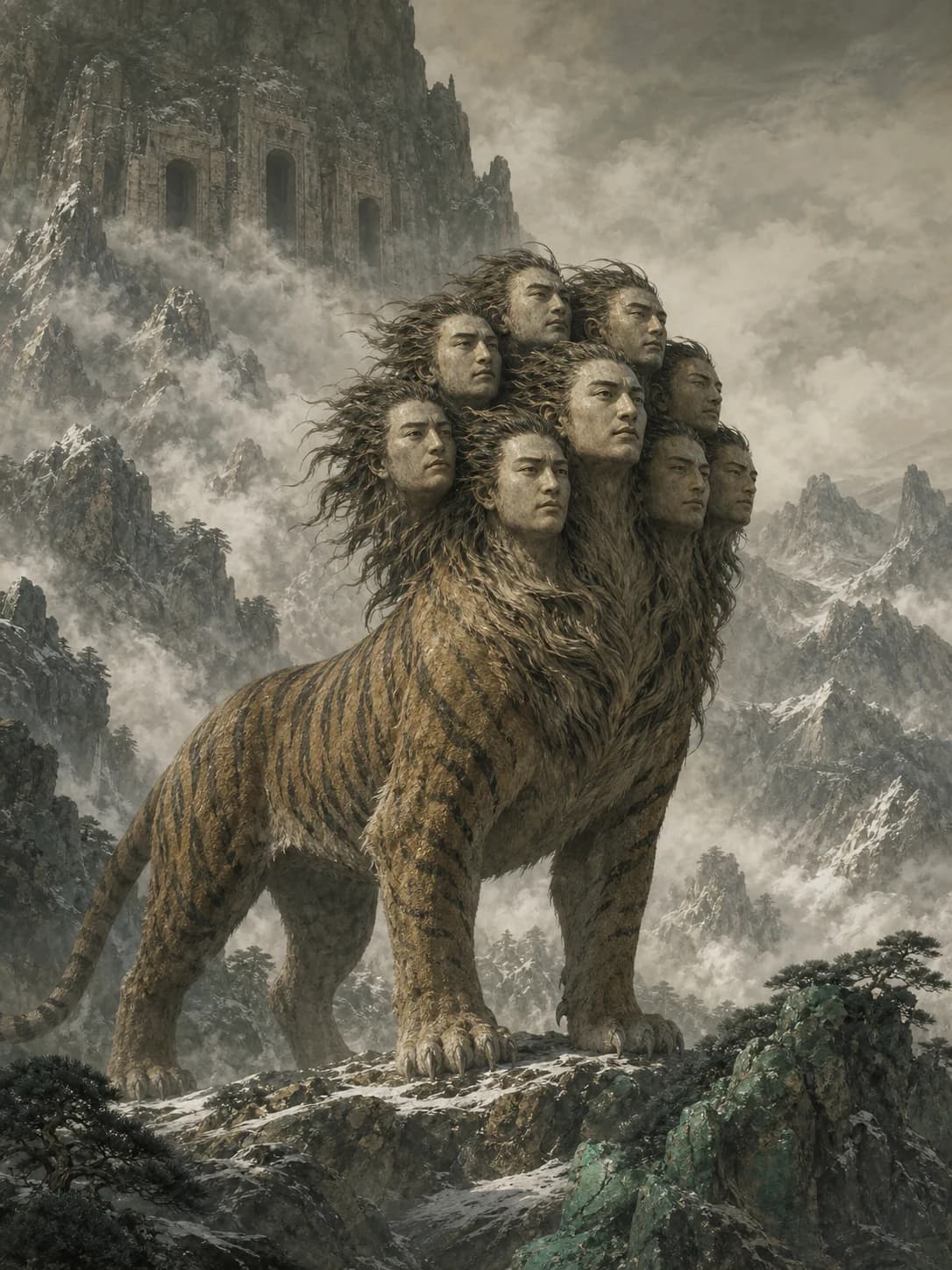
Multiplied heads form a family of their own within the book. The Classic of the Great Wilderness: West records a three-faced, one-armed son of the god Zhuanxu who is said never to die; the Land of Qigong in the western seas chapter has men with one arm and three eyes; the Kaiming beast guarding Kunlun carries nine human faces. Adding and subtracting heads and limbs is the Shanhaijing's favorite grammar for imagining foreign bodies. The Three-Headed Land is that grammar at its most economical.